Modern Indian design is often told through a familiar cast of architects, industrial designers and institutions. Yet many of the people who shaped the country's visual and material culture after Independence were women. They revived craft traditions, founded institutions, transformed textiles and fashion, reimagined domestic interiors, and established new forms of design education. Despite their influence, they remain surprisingly absent from most accounts of Indian design history. My research asks a simple question: where were the women in Indian design between 1947 and 1990? The answer, it turns out, is everywhere. They were not working at the margins of modern India but helping to define what it looked like.
Women have long played an integral role in cultural production in India, not only within the domestic sphere but as active makers, designers and producers across diverse craft traditions. From spinning cotton to weaving textiles, their labour has sustained everyday life and regional economies and shaped design sensibilities.(1) Social reforms in the nineteenth century paved the way for a small number of urban women from privileged backgrounds to enter modern professions such as education, journalism, medicine and administration. For most women, though, the nationalist movement offered the first opportunity to step beyond conservative, patriarchal domestic roles.(2)
The period between Independence and economic liberalisation was one of extraordinary cultural transformation. Nation-building demanded not only new political and economic structures but also a new visual identity. Modern architecture, industrial production, the development of craft industries and design education all became part of the larger project of building an independent India. As the architectural historian Madhavi Desai has argued, modernism offered a language through which the country could look confidently towards the future while distancing itself from its colonial past.(3)
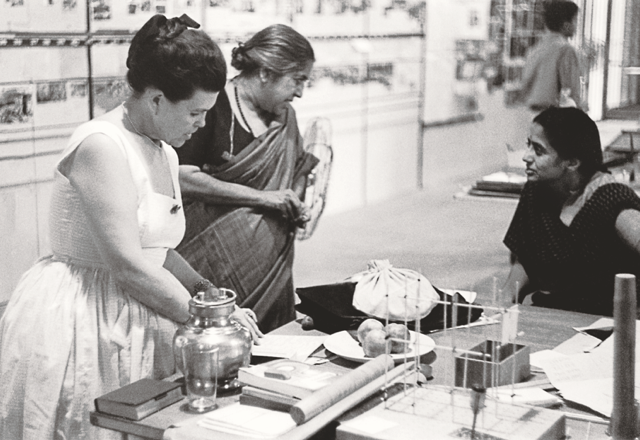
At the same time, India was redefining its relationship with its own cultural traditions. Handloom, khadi and regional crafts were widely adopted as expressions of national identity and economic self-reliance. New institutions emerged to support this vision, from the National Institute of Design in Ahmedabad to government-backed craft organisations and international cultural initiatives. Women were central to these developments, yet they have rarely been recognised as protagonists in the story.
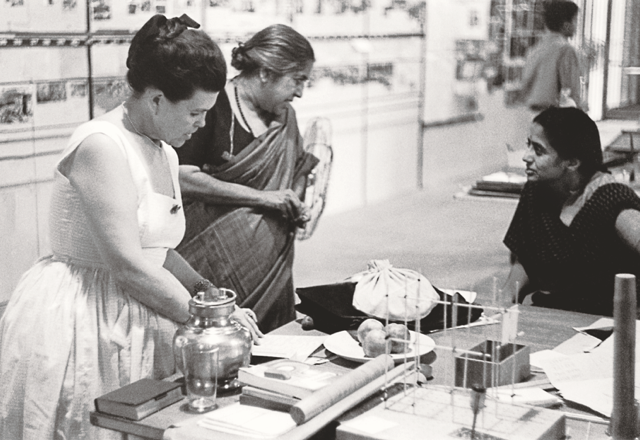
Many were institution builders. Through organisations such as the All India Handicrafts Board and the Handloom Board, Kamaladevi Chattopadhyay transformed the ideals of the independence movement into a national programme of craft revival, ensuring that traditional knowledge became part of India's modern future rather than its nostalgic past. Pupul Jayakar extended that vision through cultural policy, exhibitions and international exchange, positioning Indian craft within a global conversation. At the National Institute of Design, Gira Sarabhai helped shape a distinctive model of design education that continues to influence generations of designers.
Others expanded the possibilities of design practice itself. Bhanu Athaiya, trained as a painter before becoming one of India's most celebrated costume designers, brought historical depth and visual sophistication to Indian cinema. Asha Sarabhai and Ritu Kumar reimagined traditional textiles for contemporary fashion, demonstrating that craft could be both culturally rooted and commercially successful. Nelly Sethna and Suraiya Hasan Bose worked across textiles, industry and craft, moving between artistic experimentation and handloom revival. Meanwhile, Leela Shiveshwarkar, Shona Ray and Minnie Boga transformed ideas of the modern Indian home and interiors through furniture that balanced international modernism with local craftsmanship.
What emerges is not a collection of isolated achievements but a closely interconnected network. These women knew one another, collaborated, exchanged ideas and often built upon each other's work. Kamaladevi Chattopadhyay's advocacy laid foundations that Pupul Jayakar expanded, and Jayakar collaborated with Gira Sarabhai's educational initiative at the National Institute of Design, connecting craft, education and design thinking. Across different disciplines, they shared a belief that culture was not peripheral to nation-building but one of its essential tools.
Many also refused to recognise the boundaries that have traditionally separated art, design and craft. They were writers, artists, educators and entrepreneurs as much as designers. Their careers moved comfortably between exhibitions, publishing, museums, industry and government. Such fluidity reflected a moment when creative practice in India remained deeply interdisciplinary.
If these women played such influential roles, why have they remained largely invisible within design history? Part of the answer lies in the way histories are constructed. Their work was often collaborative, institutionally embedded or associated with craft traditions that have historically been undervalued within conventional narratives of design. Most of them did not leave formal studio archives. Their stories survive instead through scattered correspondence, private collections, oral histories and fragile institutional records. Reconstructing their contributions requires piecing together evidence from sources that were never intended to preserve a coherent professional legacy.
Their absence also reflects broader assumptions about who counts as a designer.(4) Few of these women described themselves as industrial designers, because that profession barely existed in post-independence India. Instead they worked across textiles, exhibitions, education, publishing, fashion, interiors and cultural policy: fields that have often been treated as secondary within histories that privilege products, technology and manufacturing. Yet it was precisely this breadth that enabled them to shape everyday life in modern India.
My research does not claim to be exhaustive. Many women, particularly craftswomen and those working outside metropolitan centres or elite institutions, remain undocumented. Their absence from the historical record is itself a reminder of how much work remains to be done.
Recovering these histories is therefore not simply an act of recognition. It invites us to rethink what design history values, whose work it records and how modernity itself is understood.
This piece draws on ongoing research for a book in development on women in modern Indian design between Independence and economic liberalisation.
Arpna Gupta is an independent design researcher and creative producer working in the intersections of design, craft, material culture and communities. Through her curatorial practice, Create Culture, she develops exhibitions, collaborative projects, cultural programmes and public events that connect designers, craftspeople, museums and audiences.
Bibliography
Aparna Basu and Anup Taneja, eds., Breaking Out of Invisibility: Women in Indian History (New Delhi: Indian Council of Historical Research, 2002).
Bharati Ray, ed., From Independence Towards Freedom: Indian Women Since 1947 (New Delhi: Oxford University Press, 1999).
Cheryl Buckley, "Made in Patriarchy: Theories of Women and Design," in Design and Feminism: Re-visioning Spaces, Places, and Everyday Things, ed. Joan Rothschild (New Brunswick, NJ: Rutgers University Press, 1999).
D. Fairchild Ruggles, ed., Woman's Eye, Woman's Hand: Making Art and Architecture in Modern India (New Delhi: Zubaan, 2014).
Geraldine Forbes, Women in Modern India, The New Cambridge History of India, IV.2 (Cambridge: Cambridge University Press, 1996).
Joan W. Scott, Gender and the Politics of History, rev. ed. (New York: Columbia University Press, 1999).
Madhavi Desai, Women Architects and Modernism in India: Narratives and Contemporary Practices (Abingdon: Routledge, 2016).
Philippa Goodall, "Design and Gender," BLOCK 9 (1983).
References
(1) Kamaladevi Chattopadhyay, The Awakening of Indian Women. Madras: Everyman’s Press, 1939, p33
(2) Geraldine Forbes, Women in Modern India, Cambridge University Press, 1996, p125
(3) Madhavi Desai, Women Architects and Modernism in India, Narratives and Contemporary Practices p27
(4) Philippa Goodall, "Design and Gender," BLOCK 9 (1983).
Categories
Contribute
Want to contribute to the blog and newsletter? Contact us
Newsletter
Keep informed of all Society events and activities, subscribe to our newsletter.