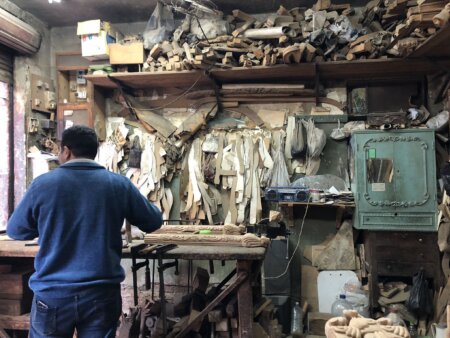
We begin in the room where one will most likely be seated on a visit to a typical Egyptian home today: the “salon” room. This room is a distinctive feature of many contemporary Egyptian homes regardless of their size and social class. It is the room dedicated to special and unexpected guests where everything is usually embellished in intricately carved and brightly gilded neo-rococo ornamentation. Whereas they were once exclusive to the palaces of both ancient and modern Egyptian kings, wealthy pashas, the aristocratic elite—and now, presidents—gilded furniture today is a glimmering feature of Egyptian popular material culture and still furnishes many contemporary homes.
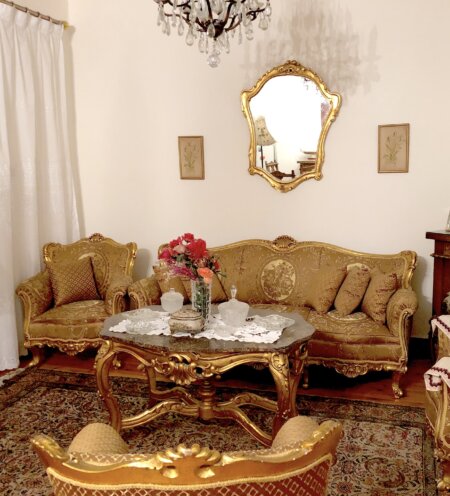
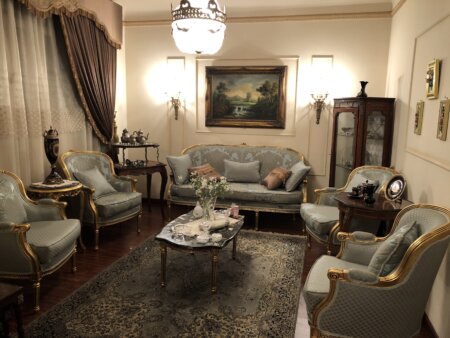
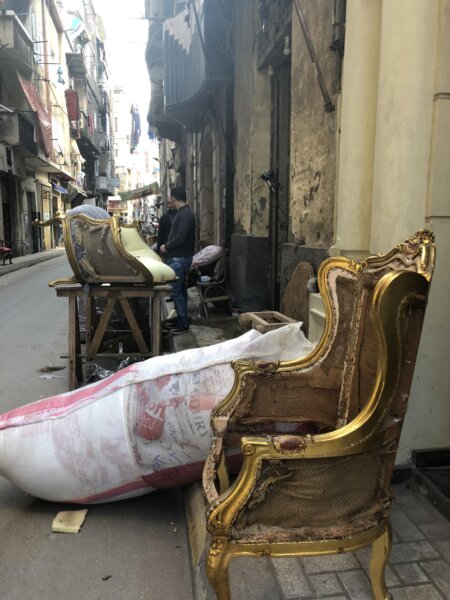
For some, the gilded salon is simply parvenu kitsch, signifying a lower social class when furnishing nouveaux-riches homes, and for others it is a natural extension to a centuries-old ancient Egyptian taste for gilded furniture. What is more, many of these have become objects discarded by their owners on the sidewalk, where they are sometimes reused as street furniture by doormen and small shop owners.
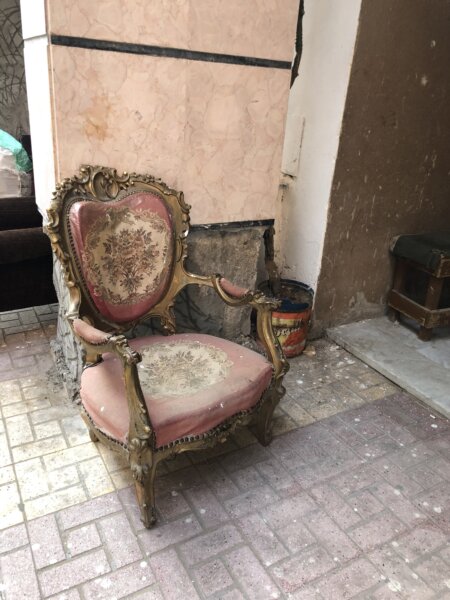
They have become part of the rubbish of the past, their gilded frames ironically glimmering on broken pavements next to piles of garbage. Thus, this salon furniture does not only occupy a special place in homes, but overflows to spaces outside the home where boundaries between past and present, private and public, old and new, blur and intertwine.
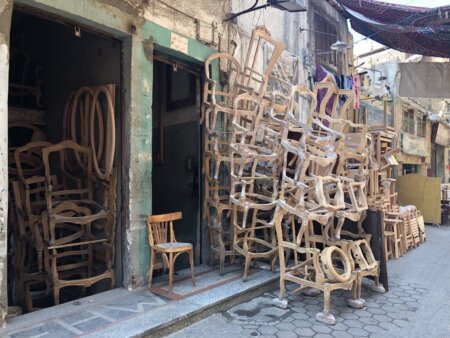
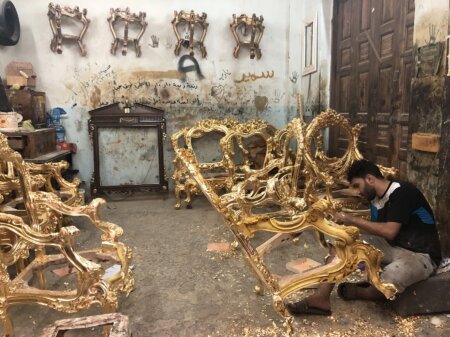
Salon furniture is not merely a décor object and a signifier of some elevated or outdated social status or taste within domestic space, but a living object that encapsulates people’s shifting social imaginaries about what is valuable, desirable, and authentic. They are locally crafted objects that hold remarkable histories, as well as spaces that mark the encounter between self and other/guest.
The salon room and its contested furniture are therefore evocative analytic starting points through which to examine larger spatio-social and spatio-epistemic tensions of contemporary Egypt. For example, such a room reflects local ideals and values of privacy, stability, hospitality, and sentiments of alienation and un-belonging—being a guest in one’s (colonized) home. In the words of one man: “The salon for me is nothing. I like the living room … the salon is not even mine—it belongs to guests.” Indeed, for many, the room felt suspended in time, a space waiting not for daily life but for important people and occasions that rarely came.
Salons embody many contradictions: they are loved and hated, rarely used but overly maintained, intimate yet formal and legitimizing, relevant yet increasingly becoming obsolete. They look European, Ottoman perhaps, but have been locally made by artisans since the early twentieth century.(1) This salon furniture has the ability to trigger visceral reactions and charged opinions that vary from laughter, scorn, and disgust to aesthetic appreciation. For many, it is dismissed as ridiculous, outdated, or inauthentic (post)colonial imitations of the European colonizer—the most undesired guest. As a locally crafted object, salon furniture is traditionally espoused as high-quality, durable, and a generally more affordable solid-wood alternative to imported fibreboard or plywood furniture. However, it is their neo-rococo style that is the primary reason their authenticity remained contested even by a highly educated elite to whom supporting local production and craftsmen’s lives was a matter of principle.(2)
Domestic salons lead fascinating anti-social lives where their invisibility and disuse - creating domestic dissonances inside apartments with limited space - are a source of annoyance for a home’s inhabitants.(3) While such negative sentiments recall those expressed against the salon’s Anglo-American counterpart - the Victorian parlour(4) - its despicability as it applies to post/neo-colonial space is entangled with issues of not only seeking membership in an unequal world (rather than simply ‘imitating the West’, as anthropologist James Ferguson has elaborated in his writing on Africa), but also the often unmet desire for authenticity (which modernity often dismisses as naïve nostalgia, reinforcing a linear timeline and a supremacy of contemporaneity).(5) In neo-colonial contexts, sentiments of un-belonging, displacement, and exile do not necessarily depend on expulsion outside nation-state boundaries, but it is the drawing of these very boundaries that cause this chokehold.(6) Within the modern nation state, these imposed and adopted boundaries extend to domestic floor plans.(7) This lingering frustration around the salon’s disuse, the irritation it procures, and the psycho-spatial dynamics it triggers increasingly revealed themselves as resonant with, and even symptomatic of, the transformation unfolding outside the home, on the street.
By centering this contested room, the following set of questions emerge: What do the unused, rarely used, or discarded states of salon rooms reveal about the role of the home? What does people’s infatuation with or aversion towards the salon room suggest about their relationship to their own homes and to the street? How does the increasing disappearance of salon rooms from homes reconfigure social lives and practices of socialization? When spaces outside the home are increasingly privatized, commercialized, and gated, who can afford to discard domestic guest rooms as irrelevant and an anachronistic space and practice?(8) (In other words, who can afford to be ‘modern’ and ‘minimalist’?)
Seated in pristine salons where I was hosted, I kept wondering: Who is setting the rules of discursive interaction in an academy that is continually seeking so-called encounters, entanglements, contradictions, and look-they-are-complex-and-original narratives? In other words, who is really interested in reading about “inspiring” resourcefulness of the colonized or their aesthetic agency in post/neo-colonial societies — and why?
Dwelling upon salon guest rooms raises larger questions not only about the social stratification caused by neoliberal urbanism and uneven development (a post/neo-colonial economic reality already well-addressed by now), but also what I call uneven hospitality, where the west is a desired space fortified with visa barriers and the east is a place of ethnographic wonder, anthropological inquiry, and an often romanticized hospitality. As I came to realize, the ‘field’ is someone else’s home, and it is in the salon room that the Self stood out clearly as someone else’s equally-scrutinized Other. The salon room is one of very few spaces on neocolonized land where the guest is put in their place—for once.
Lina El-Shamy is a cultural anthropologist, design historian, and artist. Lina's research concerns the tensions and frictions of everyday life in contemporary Egypt, especially as those relate to domestic space and objects. Her work often combines both ethnographic and archival encounters, and is driven by the prospect of recovering alternative (epistemological) worlds that could redraft ways of relating and belonging. She holds a Bachelor of Design from Ontario College of Art and Design University, and an MA and PhD from the University of Toronto's Department of Art History. Lina was born in Alexandria, Egypt, grew up in Jeddah, Saudi Arabia, and immigrated to Canada at age 15, making her life an Ibn-Battutian one full of shifting landscapes and perpetual curiosity. She is married to Mohamed Abdelfattah, and has three children: Omar, Layal, and Zeyna. In her spare time, Lina likes to play with Arabic typography, which sometimes results in designs she sells through her online shop. Find out more: www.linaelshamy.com
Bibliography
Agnieszka Dobrowolska, The Building Crafts of Cairo: A Living Tradition, American University in Cairo Press, 2005.
Diane Singerman, ed, Cairo Contested: Governance, Urban Space, and Global Modernity. Cairo and New York: American University in Cairo Press, 2009.
Daniel Miller, “Why the Best Furniture Goes to the House You Can’t Live In,” Ethnologia Europaea 37 (2008).
El-Messiri, Abdelwahab, ed, Ishkāliyyāt al-taḥayyuz: ruʾya maʿrifiyya wa daʿwā li-l-ijtihād. Cairo: al-Maʿhad al-‘ālī li-l-fikr al-islāmī, 1996.
Esra Bici Nasır, Şebnem Timur, and Meltem Ö. Gürel, “Living Rooms Occupied: Narratives on the Recontextualization of the ‘Museum-Salon’ Practice in Modern Turkish Domesticity.” Home Cultures 2020: 1-31.
Fredie Floré and Cammie McAtee, eds, The Politics of Furniture: Identity, Diplomacy, and Persuasion in Post-War Interiors. Routledge, 2017.
James Ferguson, “Of Mimicry and Membership: Africans and the ‘New World Society’,”Cultural Anthropology 17, no. 4 (2002): 551-569.
Manar Moursi and David Puig, eds. Sidewalk Salon: 1001 Street Chairs of Cairo Sidewalk Salon. Cairo and Eindhoven: Kotob Khan and Onomatopee, 2015.
“The World as Exhibition,” Comparative Studies in Society and History 31, no. 2, 1989: 217-236.
Nichola Yousef. Tārīkh dumyāṭ mundhu aqdam al-ʿuṣūr. Cairo: al-Itihad al-Qawmi bi-Domyat, 1959.
Rosfan Alex (Alexandria’s Sidewalks) @rosfanalex: https://www.instagram.com/rosfanalex
Schielke, Samuli. Egypt in the Future Tense: Hope, Frustration, and Ambivalence before and after 2011. Bloomington, IN: Indiana University Press, 2015.
Selçuk Esenbel. “The Anguish of Civilized Behaviour: The Use of Western Cultural Forms in the Everyday Lives of the Meiji Japanese and the Ottoman Turks During the Nineteenth Century,” Japan Review, no. 5 (1994): 145-185.
Thad Logan, The Victorian Parlour: A Cultural Study. United Kingdom: Cambridge University Press, 2001.
Ünver Rüstem, Ottoman Baroque: The Architectural Refashioning of Eighteenth-Century Istanbul. Princeton, NJ: Princeton University Press, 2019.
Yahia Shawkat, Egypt’s Housing Crisis: The Shaping of Urban Space. American University in Cairo Press, 2020.
References
See Ünver Rüstem, Ottoman Baroque: The Architectural Refashioning of Eighteenth-Century Istanbul (Princeton, NJ: Princeton University Press, 2019).
See, for instance, the writing of the prominent Egyptian intellectual Abdelwahab El-Messiri who explicitly criticized the “Western salon”: Ishkāliyyāt al-taḥayyuz: ruʾya maʿrifiyya wa daʿwā li-l-ijtihād (Cairo: al-Maʿhad al-‘ālī li-l-fikr al-islāmī, 1996) — published in English as Epistemological Bias in the Physical and Social Sciences (International Institute of Islamic Thought, 2006).
I use “anti-social lives” here as an inversion to anthropologist Arjun Appadurai’s seminal "The Social Life of Things: Commodities in Cultural Perspective (Cambridge, UK: Cambridge University Press, 1986), where the invisibility and un-usedness of objects have anthropological dimensions worth observing.
See Thad Logan, The Victorian Parlour: A Cultural Study (Cambridge, UK: Cambridge University Press, 2001).
James Ferguson, “Of Mimicry and Membership: Africans and the ‘New World Society’,”Cultural Anthropology 17, no. 4 [2002]: 551-569).
See Samuli Schielke, Egypt in the Future Tense: Hope, Frustration, and Ambivalence before and after 2011 (Bloomington, IN: Indiana University Press, 2015).
In the context of the colonial architecture of modern Egypt, Timothy Mitchell has described the top-down “model housing” system as “enframing”— that is, containing and dividing up new spaces for reconfiguring what is possible and visible. See his essay “The World as Exhibition,” Comparative Studies in Society and History 31, no. 2, 1989: 217-236.
Diane Singerman’s edited volume Cairo Contested: Governance, Urban Space, and Global Modernity (Cairo and New York: American University in Cairo Press, 2009) captures with great sensitivity many aspects on the dismantling of Cairo’s urban fabric.
Categories
Contribute
Want to contribute to the blog and newsletter? Contact us
Newsletter
Keep informed of all Society events and activities, subscribe to our newsletter.