Art education in colonial South Asia expanded through the four schools of art that opened in the 1850s, starting with the Madras School of Industrial Art (1850),Calcutta School of Industrial Art (1854), Jamsetjee Jeejeebhoy (or J.J.) School of Industrial Art in Bombay (1857), and, in Lahore, the Mayo School of Industrial Art in 1875. Despite their standardised curricula, the art schools often turned to their local milieu for pedagogy and making practices. Rather than examining the workings of A particular art school through its success or failure in applying the South Kensington-style curriculum, one can focus on an object or a process of making an object, such as a piece of furniture, to investigate how pedagogical practices really worked at the art schools. One may also re-examine terms and categories such as ‘furniture’ and use them to query art and design education, which had its share of vernacular connections to local forms as much as to the South Kensington system through its global following.(1)
Using a transregional lens, art and design education in colonial South Asia calls for an exploration of art schools’ student works and teaching materials, along with addressing certain gaps, especially regarding the role of caste-based work, craftspeople, and their entanglements with the art schools. Focusing on the early history, starting from the 1850s, is crucial in reflecting upon the shifts, comparisons, exchanges, resonances, prejudices, and pragmatics that tied the art schools to varied artistic/artisanal transregionalities that inform a tacit syllabus of art education. Pamela H. Smith’s formulation of ‘artisanal epistemologies’ is a useful method for this research.(2)
The case of woodwork in the Punjab – the region partitioned in 1947 – illustrates how a transregional framework applied to woodwork at the Mayo School of Art can highlight ‘artisanal epistemologies’ that shaped industrial education at the Mayo School of Art, Lahore.
Looking at Craftspeople Drawings
Readers of this blog may have come across the drawings of craftspeople. Given the visual tropes, these works formed what are known as ethnographic displays in museums and exhibitions, modelled or performative.(3) The ubiquity of such drawings in the late 19th century calls for a deeper reflection given the transregional presence of artisans and their strategies of making.(4)
When looking at the examples of woodwork in the Punjab, the drawing of a woodcarver by the future principal of the Mayo School of Art, Lahore, is a good starting point.(5) One can notice how the ‘Body at Work’ dominates the frame, pushing all else to the margins.(6) However, something sat uncomfortably between Kipling’s drawings – 52 in total – and a painting made by the likes of Kehar Singh, a local artist from the region or those painting in his style.(7) It is as if these works were trying to bring out the maker and the process of making something very specific.
Despite the caption, ‘A Carpenter at Work’(8), a closer look at the person and their tools – ‘Tesha’, adze, ‘Sathra’ or chisel used to shape the legs turned on the ‘Barma Kumancha’(9) - points to specific methods of making, revealing that the person depicted was not just a ‘carpenter’ in a karkhana. More specifically, they are a kharadi or a turner, who works on a lathe to produce wooden legs. These can be used to make a manja/charpoy or a four-legged bed, a pidha or a pidhi, a low chair, and a charkha or spinning wheel.(10) Upon entering the museum, these histories of use and making have been oversimplified under categories such as ‘furniture’. Vernacular furniture in parts of Pakistan and India belongs to quotidian life and shared spaces inhabited by objects “saturated with memory”.(11)
Cityscapes to Furniture
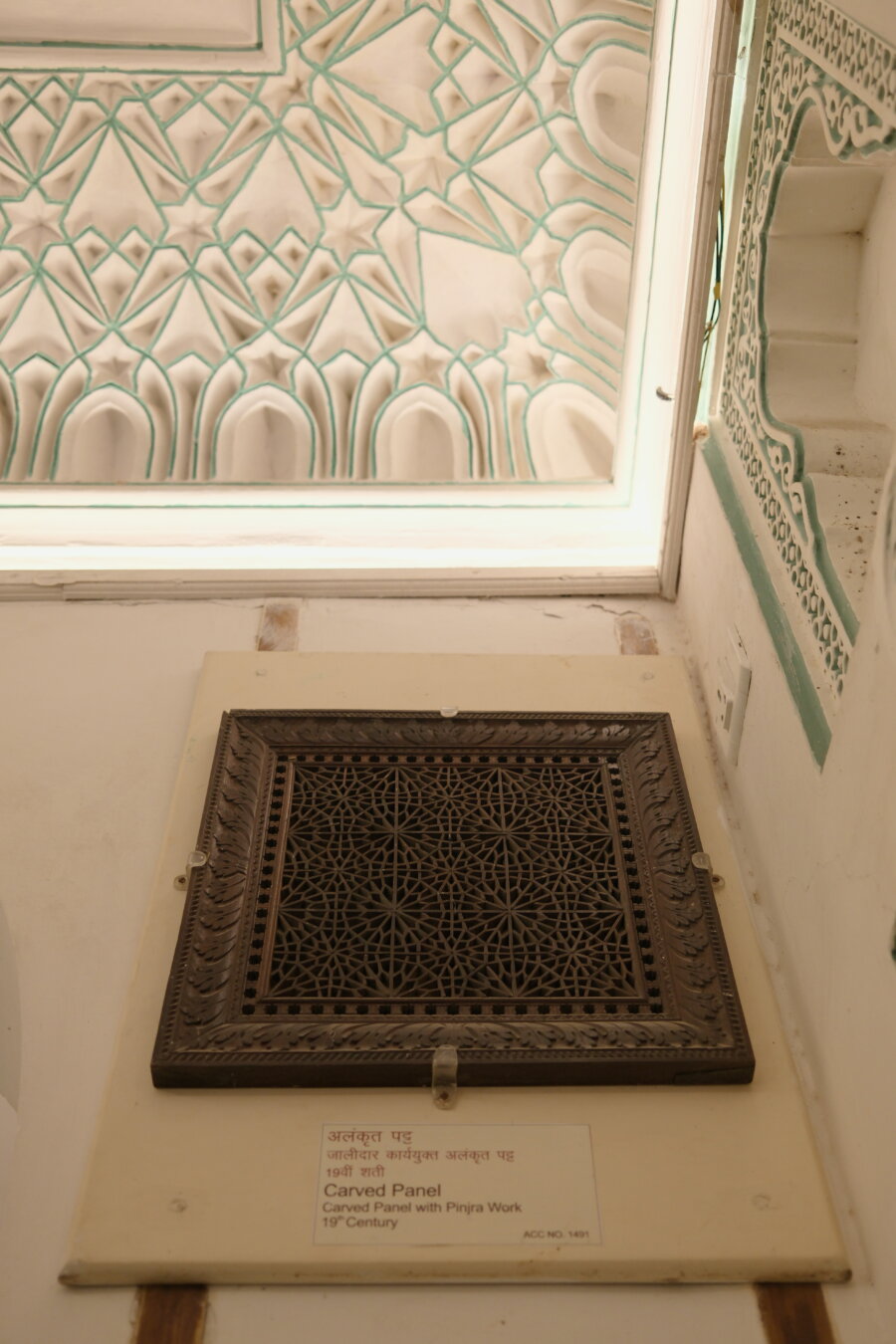
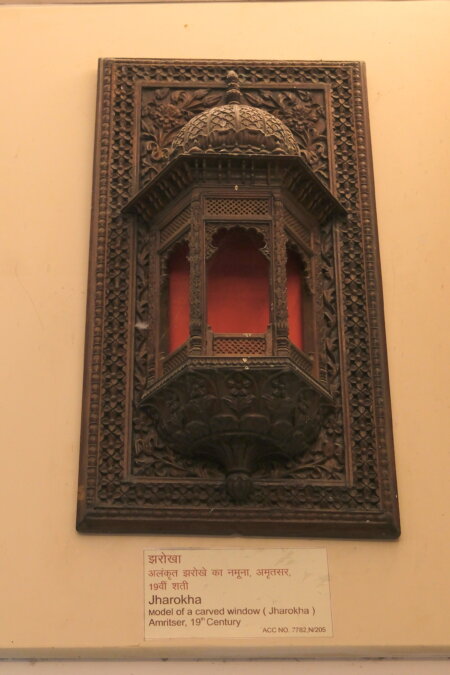
Surrounding the Mayo School of Art in Lahore was a bustling city. If you walk the streets in Old Lahore, Kashmir, or Amritsar, you might still be able to see an old merchant home.(12) Standing next to one another, these houses often had a bukharcha, or oriel window that projects from a building (Fig. 1). It has a domical roof and is supported by brackets at the bottom.(13) One can notice the mesh of lattice, Pinjra, or Jali work (Fig. 2) applied to these bukharchas as architectural decoration. Called Pinjra/Mauj/Jali/Girih, these forms of geometrical lattice work are applied as architectural decoration. These help separate the outer and inner parts of a household while allowing fresh air and some light to trickle in, and keeping away any unwanted gaze.
Vernacular glossaries and artisanal manuals, such as Geometrical Patterns with their Descriptions in English, Urdu & Gurmukhi (1893), describe different Jali designs using local metaphors and languages, such as Punjabi and Urdu.(14) As a rare record, Kishen Singh’s how-to manual was meant to democratise artisanal epistemologies for designers, art students, and even children, hitherto meant for a master craftsperson’s apprentice.(15)
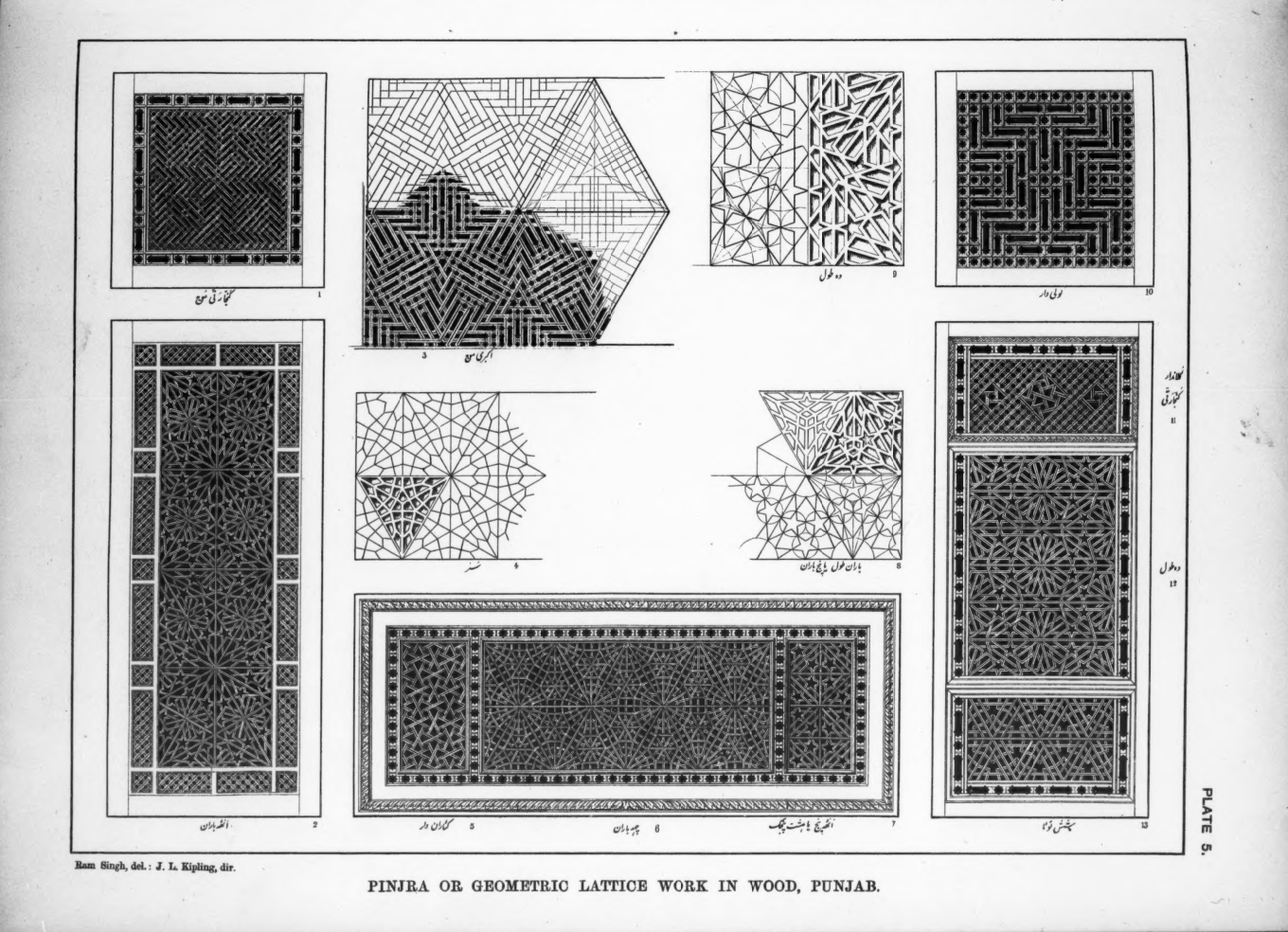
Woodwork executed by art students and craftspeople helped the Woodwork Department, which later became the Mayo School of Art, gain considerable prominence both within and beyond the region. Pinjra work was introduced at the Mayo School of Art under the aegis of Kipling and master craftsperson Ram Singh (Fig. 3).(16) Subsequently, Jalis were applied to windows, screens, doors, and pieces of furniture.(17) Lattice work entered the Mayo School of Art through the streets of broader Punjab. Jalis applied to furniture or as decoration reveal an osmosis of craft techniques, artisanal epistemologies, vernacular motifs, materials, and skills at the art school in Lahore. Art education, when seen through the lens of transregionality, thus reveals how craftspeople participated in and negotiated their way through making design histories.
Tanya Talwar is a postdoctoral researcher at Humboldt-Universität zu Berlin (HU) as part of the research consortium De:link//Re:link – Local Insights and New Knowledges. She completed her thesis at Institut für Kunst- und Bildgeschichte (Institute for Art and Visual History) at HU in 2026, which was about art education in colonial South Asia with a transregional focus on art schools in Madras, Calcutta, Bombay, and Lahore. Her research interests include artistic and aesthetic education in colonial South Asia, transregional and transcultural histories of art, artisanal practices and epistemologies, and the role and silences around caste in Art and education.
Bibliography
Amin Jaffer. Furniture from British India and Ceylon: A Catalogue of Collections in the Victoria and Albert Museum and the Peabody Essex Museum. 2001.
Bryant, Julius, and Susan Weber, eds. John Lockwood Kipling: Arts & Crafts in the Punjab and London. Published by Bard Graduate Center Gallery ; Yale University Press, 2017.
Dewan, Deepali. ‘Crafting Knowledge and Knowledge of Crafts: Art Education, Colonialism and the Madras School of Arts in Nineteenth-Century South Asia’. University of Minnesota, 2001.
Dutta, Arindam. The Bureaucracy of Beauty: Design in the Age of Its Global Reproducibility. Routledge, 2007.
Goswamy, B. N. Piety and Splendour: Sikh Heritage in Art. National Museum, 2000.
Ingold, Tim. Making: Anthropology, Archaeology, Art and Architecture. Routledge, 2013.
Jain, Rishav, Ben Cartwright, Mansi S. Rao, and Abhishek Ruikar. Catalogue of Vernacular Furniture. Punjab: As Part of the Vernacular Furniture of North-West India Project : Phase III. First edition. CEPT University Press, 2021.
Marg. ‘Punjab Folk Arts’. December 1974.
Mathur, Saloni. India by Design: Colonial History and Cultural Display. Edited by Saloni Mathur. University of California Press, 2007. https://doi.org/10.1525/9780520941052.
McGowan, A. Crafting the Nation in Colonial India. Palgrave Macmillan US, 2009.
Mills, James H., and Satadru Sen, eds. Confronting the Body: The Politics of Physicality in Colonial and Post-Colonial India. Anthem South Asian Studies. Conference ‘Representing the Body in Colonial and Post-Colonial South Asia’. Anthem Press, 2004.
Singh, J. Kishen. Geometrical Patterns, with Their Descriptions in English, Urdu and Gurmukhi. Oriental Press, 1893.
Smith, Pamela H. The Body of the Artisan: Art and Experience in the Scientific Revolution. University of Chicago press, 2004.
References
(1) Arindam Dutta, The Bureaucracy of Beauty: Design in the Age of Its Global Reproducibility (Routledge, 2007), 23
(2) Pamela H. Smith, The Body of the Artisan: Art and Experience in the Scientific Revolution (University of Chicago press, 2004)
(3) Saloni Mathur, India by Design: Colonial History and Cultural Display, ed. Saloni Mathur (University of California Press, 2007), https://doi.org/10.1525/9780520941052; Deepali Dewan, ‘Crafting Knowledge and Knowledge of Crafts: Art Education, Colonialism and the Madras School of Arts in Nineteenth-Century South Asia’ (University of Minnesota, 2001); A. McGowan, Crafting the Nation in Colonial India (Palgrave Macmillan US, 2009)
(4) Tim Ingold, Making: Anthropology, Archaeology, Art and Architecture (Routledge, 2013)
(5) ‘A wood carver’, drawing by John Lockwood Kipling, 1870, Accession number: 0929:56/(IS), Victoria and Albert Museum collections, URL: https://collections.vam.ac.uk/item/O69194/a-wood-carver-drawing-lockwood-kipling-john
(6) Reference to Deepali Dewan’s essay, ‘The Body at Work: Colonial Art Education and the Figure of the ‘Native Craftsman’, in James H. Mills and Satadru Sen, eds, Confronting the Body: The Politics of Physicality in Colonial and Post-Colonial India, Anthem South Asian Studies, (Anthem Press, 2004)
(7) It remains unclear whether Kehar Singh himself made the drawings printed in B.N. Goswamy, Piety and Splendour: Sikh Heritage in Art (National Museum, 2000), plates 180-184. The same image in black and white is printed and attributed to Kehar Singh in Marg, December 1974, vol. xxviii, plate 33. Similar copies of craftspeople’s drawings are attributed to Singh or to ‘his style’
(8) Refer to cit. 6
(9) Goswamy, 219. B.H. Powell, Hand-book of the Manufactures of Arts of the Punjab, Vol. 2 (Punjab Printing Company, 1872), 299
(10) Rishav Jain et al., Catalogue of Vernacular Furniture. Punjab: As Part of the Vernacular Furniture of North-West India Project: Phase III, First edition (CEPT University Press, 2021), 50-57, 74-104
(11) Jain, 1-2
(12) Print from negative 11547, V&A Museum printed in Julius Bryant and Susan Weber, eds, John Lockwood Kipling: Arts & Crafts in the Punjab and London (Published by Bard Graduate Center Gallery; Yale University Press, 2017), 127
(13) In some regions, this balcony is also referred to as a Jharokha
(14) J. Kishen Singh, Geometrical Patterns, with Their Descriptions in English, Urdu and Gurmukhi (first edition, Sant Singh Luther Oriental Press, 1893)
(15) Singh, Preface, text in Punjabi translated by author
(16) The Journal of Indian Art, Vol. I, 1886, No. 4, Plate 5. See, Nadhra Shahbaz Khan’s article in Julius and Byrant (eds), John Lockwood Kipling, 469-487
(17) Photograph from an album entitled 'Photographs. Calcutta International Exhibition. 1883-84', 68, accession number 3185-1930, V&A Museum collections. The upper half of the cabinet is decorated using jali designs. Amin Jaffer, Furniture from British India and Ceylon: A Catalogue of Collections in the Victoria and Albert Museum and the Peabody Essex Museum (2001), 293
Categories
Contribute
Want to contribute to the blog and newsletter? Contact us
Newsletter
Keep informed of all Society events and activities, subscribe to our newsletter.