Chandigarh’s modernist furniture was designed and constructed to furnish the newly built city of Chandigarh, India. Developed to serve as the Indian Punjab’s new capital and administrative center, the city and its furniture were created by a multinational team including Aditya Prakash, Urmila Eulie Chowdhury, Jeet Malhotra, Le Corbusier, Pierre Jeanneret, Jane Drew, and Maxwell Fry.[1]
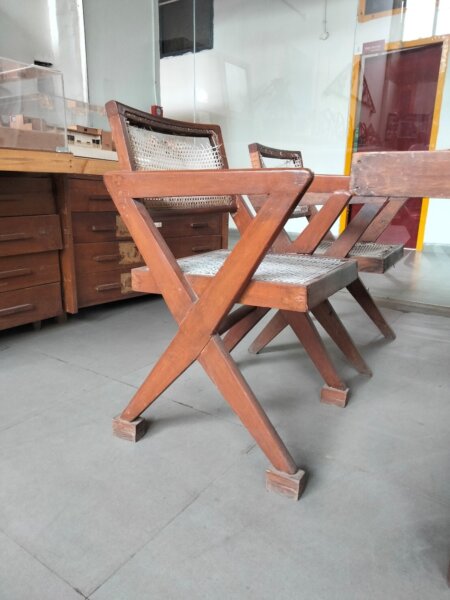
Chandigarh’s furniture shares a broadly unified visual aesthetic. Comprising pared-back geometric forms, the pieces are constructed of angular, thick-cut joined native timber, with caning, leather upholstery and glass added where appropriate for form and function. Pieces were introduced to city buildings over the course of Chandigarh’s construction, and it is within these locales that the furniture remained until roughly 1999. At this time two French antique dealers and gallerists, Eric Toucheleaume and Gerard Moreau, took a ‘prospecting trip’ to the city.[2] This would be their first of over 30 trips in the following 11 years; trips during which the duo purchased objects at municipal auctions, removed the pieces to France, had the furniture refurbished, published and exhibited the objects, and finally listed pieces at auction.[3]
This sequence of events has proved to have been wildly successful. Modernist furniture from Chandigarh is now sold for incredibly high prices, including a library table reaching over $300,000 at auction.[4] Chandigarh chairs have been featured in leading international publications and the pieces have found prominent positions in the homes of the rich and famous.[5] On the surface this would appear to be a rare ‘win’; the entrance of South Asian design into the Modernist canon. However, this ideal situation has not necessarily been the reality.
Throughout press coverage, auction sales, and gallery exhibits, Chandigarh’s furniture is identified as the solo work of Pierre Jeanneret.[6] This minimizes the role of the many brilliant Indian designers, architects, and craftspeople that have doubtlessly played a significant role in creating and maintaining this furniture.[7] Further, the pieces are categorized as being works either French or Swiss, rather than Indian, design.[8] This erases the contributions of Indians to the furniture’s design and construction, furthering racist suggestions of modernist design as a European endeavor.[9] Worse yet, it is frequently suggested that Indians have neither properly appreciated nor cared for Chandigarh’s historic furniture, a depiction contrasted with that of collectors from the (over)developed world who are said to have ‘saved’ pieces by purchasing them.[10]
Continuing issues around access add fuel to the fire. High prices incentivize the (now illegal) removal of pieces from Chandigarh, taking access away from the very community for whom pieces were was designed. Incentive for removal has also had the knock-on effect of pressuring local government and authorities to protect the city’s furniture heritage from theft and export by placing items under lock and key; a process which in addition to stemming illegal export, further decreases access.[11]
These problems unquestionably stem from weighty socio-political issues around colonization, racism, and extractive capitalism. They may also emerge, at least in part, from the frameworks of monetary value through which design is often evaluated. This is, fortunately, a framework within which design historians and furniture connoisseurs are well positioned to serve as changemakers through the introduction of a paradigm of use.
Much of the intellectual base behind paradigms of use come from native communities across the world, for whom many of the so-called ‘priceless treasures’ held in the world’s leading museums are not objects solely intended to be viewed behind glass cases, preserved in stasis for eternity, but instead are living objects and entities, created for practical purposes.
Motivated by different ways of seeing, conservationists have questioned the mantra ‘that keeping things for longer is better.’[12] Understanding historical conservation practices as a ‘fake neutrality’ which, in reality, is the triumph of White Western values and meanings at the expense of all others, radical conservationists now encourage use of historical items, particularly where such use can serve as a bridge between past and present, and between objects and source communities.[13] This approach is particularly well suited to objects of design, given the centrality of use to designed objects. What sets chairs, bowls, books, cars, and clothing apart from other beautiful objects like paintings and sculptures is that the former have practical and functional uses, and the latter do not.[14]
Looking at Chandigarh’s furniture through a paradigm of use-value helps to de-escalate the situation. When a standard library chair is seen as being a financial entity with the equivalent value of a house, conversations around where this chair should be, who should have access to it, what this access should look like, and how it should be maintained are difficult, tense, and fraught. But without the financial element many of these pressure points dissipate.
A value-paradigm of use also helps to replace neo-colonial assertions that Indian people have not appropriately valued for Chandigarh’s furniture. If the gold standard for appreciating objects of design is seen as using them, then Chandigarh’s residents deserve a gold star. Whether in the high court, the secretariat, hostels, libraries, hospitals, or museums Chandigarh’s furniture has been pressed into daily use by over three generations of citizens. The physical objects themselves bear witness to these decades of diligent use, wear, tear, repair, and re-use. Looking at the pieces it’s hard to miss their re-caning, undertaken after years of sitting which will have worn away original cane work, the tears and re-upholstery of arms of armchairs, the result of countless hands using these appendages to push themselves into a standing position, and the doodles of university students on desktops. In a financial value paradigm these are all signs of misuse. But in a paradigm of use these physical changes, alongside stories of generations of Chandigarh residents’ experience and familiarity with the pieces, are the ultimate signs of appreciation.
Particularly when dealing with objects from the global south, emphasizing stories of use can root objects in their original communities, cultures, and value systems, in some ways combatting fetishization. In the eyes of the design market a chair designed by Le Corbusier, or Le Corbusier’s cousin, is sexy and desirable. A chair sat in for years by a mid-level Indian bureaucrat, on the other hand, is less so. By emphasizing the story of an Indian judge’s years of Chandigarh chair experiences, rather than just the ideas of Pierre Jeanneret, then, we can build important object knowledge, and do so in a way which resists commodification and reflects the object’s authentic self.
Petra Seitz is a design and architectural historian specializing in the political economy of design. She holds a BA from Oberlin College, MA from the Royal College of Art/Victoria & Albert Museum, and PhD from the Bartlett School of Architecture, UCL, and has lectured at the University of Greenwich and the Bartlett School of Architecture. Find out more about Petra's research here.
[1] Kiran Joshi, Documenting Chandigarh The Indian Architecture of Pierre Jeanneret, Edwin Maxwell Fry, Jane Beverly Drew (Mapin, 1999).
[2] Eric Touchaleaume and Gerard Moreau, Le Corbusier Pierre Jeanneret: L’aventure Indienne : Design - Art - Architecture (Gourcuff Gradenigo, 2010).
[3] Touchaleaume and Moreau.
[4] Petra Seitz et al., “Chandigarh Furniture Auction Tracking Database,” November 21, 2021, https://docs.google.com/spreadsheets/d/e/2PACX-1vQ5fPeMkyM_c2Vb-YF4eOfy95Xub0QVMS61-SJ8C2Cj8xKePPzvKoOiduC_hdSgXvswaO_XEfjbhLyB/pubhtml?gid=0&single=true.
[5] Amelia Gentleman, “A City That Sat on Its Treasures, but Didn’t See Them,” The New York Times, March 19, 2008, https://www.nytimes.com/2008/03/19/world/asia/19chandigarh.html; Sarah Medford, “Is Your Jeanneret a Fake?,” Wall Street Journal, August 14, 2019, https://www.wsj.com/articles/is-your-jeanneret-a-fake-11565785593; Mayer Rus, “Step Inside Kim Kardashian West and Kanye West’s Boundary-Defying Home,” Architectural Digest, February 3, 2020, https://www.architecturaldigest.com/story/kim-kardashian-kanye-west-home.
[6] Seitz et al., “Chandigarh Furniture Auction Tracking Database.”
[7] Petra Seitz et al., “Design Crime in Context: Mass-Manufactured Design, Design-as-Art, and Chandigarh’s Modernist Furniture,” in Art Crime in Context, ed. Naomi Oosterman and Donna Yates, Studies in Art, Heritage, Law and the Market (2022), https://doi.org/10.1007/978-3-031-14084-6_3.
[8] Seitz et al., “Chandigarh Furniture Auction Tracking Database.”
[9] Seitz et al., “Design Crime in Context: Mass-Manufactured Design, Design-as-Art, and Chandigarh’s Modernist Furniture.”
[10] Gentleman, “A City That Sat on Its Treasures, but Didn’t See Them”; Touchaleaume and Moreau, Le Corbusier Pierre Jeanneret: L’aventure Indienne : Design - Art - Architecture.
[11] Akashdeep Virk, “8 Years on, Heritage Furniture Gathers Dust at Police Station,” The Tribune, October 14, 2024, https://www.tribuneindia.com/news/chandigarh/8-years-on-heritage-furniture-gathers-dust-at-police-station/.
[12] Jane Henderson, “Beyond Lifetimes: Who Do We Exclude When We Keep Things for the Future?,” Journal of the Institute of Conservation, 2020, 1–18, https://doi.org/10.1080/19455224.2020.1810729.
[13] Jules Pelta Feldman, “Conserving Performance, Performing Conservation: Kim Kardashian x Marilyn Monroe,” Studies in Conservation 69, no. 6 (2024): 369–87, https://doi.org/10.1080/00393630.2023.2260628; Eleanor Sweetnam and Jane Henderson, “Disruptive Conservation: Challenging Conservation Orthodoxy,” Studies in Conservation 67, nos. 1–2 (2022): 63–71, https://doi.org/10.1080/00393630.2021.1947073.
[14] Richard Redgrave and Gilbert Redgrave, Manual of Design (Crystal Palace Press, 1882).
Categories
Contribute
Want to contribute to the blog and newsletter? Contact us
Newsletter
Keep informed of all Society events and activities, subscribe to our newsletter.