Working in Pattani Archives- a family archive based in Bhavnagar, Gujarat, India- we are surrounded by objects that have survived across generations. Although accustomed to their presence, they have prompted us to look beyond their material appearance and ask questions about their makers, uses, and historical contexts. A bookcase raised a question about its maker; a study desk led us to consider how personal memories can be situated within broader histories; a marble-top table opened a path into the history of Indian craftsmanship.
What initially appeared to us as ordinary furniture became clues to a larger history of colonialism, craft, craftsmanship, and adaptation. Our approach has emerged from multiple disciplinary perspectives. None of us began this inquiry as specialists in furniture or craft research. Instead, our observations, shaped by different disciplinary positions and ways of looking at material culture, including archaeology, history, museology, archival practice, heritage studies, and personal experiences, influenced the questions we asked, and consequently, the histories we could trace.
A Bookcase
Our library cupboards were some of the first objects to attract our attention. One bookcase has a metal plate bearing the name: “Mistry Nagji Purshottam, Cabinate Maker, Bhavnagar” (Figure 1). Its clean, modular form resembles an Edwardian-era (1901-1914) barrister bookcase (Quinz, 2025).
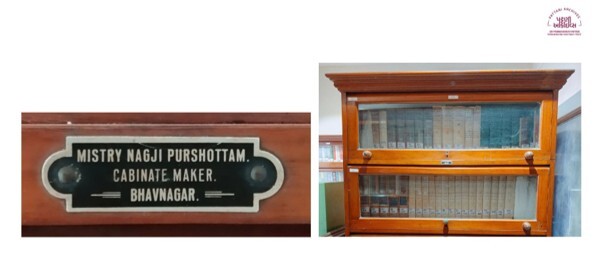
Right: Bookcase in the Pattani Archives Library (Credit: Pattani Archives, 2026)
This bookcase became our entry point into an investigation of Anglo-Indian furniture style and its origins in Portuguese colonies in Goa, Daman and Diu, where it was first seen in churches before reaching offices and homes.
Yet when we attempted to locate its regional history, we encountered a significant gap. We could not find sources documenting Nagji Purshottam or a furniture firm associated with his name in Bhavnagar. More importantly, we found little accessible scholarship in Gujarati that could help us trace the history of local cabinet makers and their relationship with wider furniture traditions.
The question was no longer simply what the bookcase looked like, but who made it, where it was made, and how a design associated with a wider colonial furniture tradition came to be produced in Bhavnagar.
A Study Desk
The study desk is designed as an integrated unit, with the chair and writing surface attached. Wheels aid the movement of the heavy piece, while the table has a wide writing surface, lockable storage, and a sliding mechanism that allows the writing surface to move forward for ergonomic adjustment.
We noticed that its design resembles school benches, prompting us to explore broader histories of education as well as the family's memories around it. This combination of material observation and family memory raised questions about the relationship between domestic experience and wider histories of education.
We investigated its possible relationship to colonial education, where such a design could have contributed to particular routines and forms of discipline. As Mason (2023) articulates, “it situates our body in a particular set of relations with other objects, people and power structures; impacting upon our ideas and values we (re)produce and propagate.”
While recording the family's memory, we discovered that the desk had been used by three generations of the Pattani family, particularly by children for study. However, tracing the history of educational furniture in India, particularly through regional sources, was difficult.
In this sense, the desk became a point where family history, educational history, and regional history intersect.
A Bookshelf
Among the furniture in our archival collection are two revolving bookshelves distinguished by their four-sided rotating structure. One bears a metal plate inscribed with “P. D. Pattani, ESQ”, indicating its owner rather than its maker, unlike the barrister bookcase discussed previously. Another has vertically slatted panels, doors, and an adjustable writing surface.
A well-known example of this type of bookcase is the Champion Case, patented by John Danner. In his catalogue, Danner warned against imitations of his design and stated that “action would be taken in cases of infringement.”
The resemblance between the bookshelves in our collection and Danner’s design raises questions about how furniture designs circulated, how makers encountered and reproduced existing forms, and how distinctions between original design, imitation, and adaptation were understood across contexts.
Drawing on Guha’s (2024) discussion of craft histories within their wider social and historical contexts, linking craft histories to these contexts might help us understand craft production as networked and transregional economies, with a focus on the social status of craft and craftsmen in colonial times.
A Marble- Top Table
Another significant piece of furniture in our archive is a marble-top table. We use it to arrange documents, books, and research materials, and to photograph archival objects. At one point, it was also used as a dressing table by the family!!
A distinctive feature of this table is the inlay work on the drawers.
A union of European design ideas and Indian craftsmanship, the use of inlay work draws upon traditional skills practised by Indian artisans (Head, 1988). Jaffer (2001) similarly discusses the interaction between European design and Indian craftsmanship, in which objects signified dialogue between both.
Unlike the other three objects, where our evidence has led us towards questions of craftsmanship, adaptation and design ownership, the marble-top table offered a more visible encounter with precolonial Indian craft traditions. Identifying the technique is only one part of understanding the object. The identities of the artisans, the networks through which their skills were transmitted, and the regional contexts in which such work was produced remain questions requiring further investigation.
Situating the objects in wider historical context
Our inquiry into these four objects taught us to analyse archival furniture beyond its physical features and ask questions about its makers, users, movements, adaptations, and historical significance. At the same time, each investigation brought us back to what remains undocumented.
If the histories of local craftsmen and their work are to become part of wider discussions of material culture, they need to be documented and disseminated beyond academic audiences and English-language scholarship. It is our effort at Pattani Archives to highlight these gaps in regional resources and initiate research in vernacular languages to bring forth local histories into wider conversations.
Aashka Kamdar is an Archival Assistant at Pattani Archives. She holds a B.A. in Archaeology from The Maharaja Sayajirao University Baroda and an M.A. in Managing Archaeological Sites from UCL Institute of Archaeology. Her research interests include heritage interpretation, digital heritage, and the archival documentation of regional narratives. At Pattani Archives, she works on rare book identification and research.
Shevang Berani is an Archival Assistant at Pattani Archives. He completed his schooling in Gujarati medium and pursued higher education in History from Maharaja Krishnakumarsinhji Bhavnagar University. His interests lie in documentation, heritage interpretation, and digital heritage. His work involves engaging with archival collections and researching how historical objects and materials can be documented, interpreted, and made accessible to wider audiences.
Bibliography
- Danner J (1884?), Illustrated and descriptive circular of Danner's revolving book cases, John Danner Manufacturing CO., Canton, Ohio. Available on the Internet Archives.
- Guha, S., (2024), Craft and Its Representations: Thinking Through the Pre-Colonial Histories of Craft Practices in India. The Routledge Handbook of Craft and Sustainability in India, edited by Tanishka Kachru and Rebecca Reubens.
- Head, R., (1988). Indian Crafts and Western Design from the Seventeenth Century to the Present. RSA Journal, 136(5378), 116–131.
- Jaffer, A., (2001), ‘Furniture from British India and Ceylon ’, V&A Publications
- Mason, A.R., (2023) ‘Decolonisation and Desk’ The Affects of Pedagogy in Literary Studies (pp-161-173), Routledge.
- Quinz, J (2025), ‘Barrister Bookcases’ Available here: Barrister Bookcases History Value And Styling Tips
Categories
Contribute
Want to contribute to the blog and newsletter? Contact us
Newsletter
Keep informed of all Society events and activities, subscribe to our newsletter.