Peter Grace, Masters student in Social Ecological Design at Istituto Europeo di Design Torino, reports on the 2026 Annual Conference as recipient of the Student Speaker Bursary...
At this year’s DHS Conference, the theme of Design in an Age of Uncertainty brought together researchers and scholars to share their work on design addressing precarity and the unknown in the past, present, and future. My master’s program in Social Ecological Design at IED Torino has done the same. In the past year, I have seen multiple scholars evoke Gramsci’s “Age of Monsters” to describe the current state of our world and how designers must relate to it (namely the student keynote speaker, Zeina Maasri, and my own professor, design ethnographer Michael Kaethler). In his Prison Notebooks developed during his time in captivity under the Italian Fascist regime, Gramsci wrote that “the old world is dying, and the new world struggles to be born: now is the time of monsters”.
This uncertainty is perhaps always present, but it is felt to greater and lesser extents at different times and geographical contexts. As I attended presentations by researchers and practitioners from across disciplines, I observed that responses to this uncertainty often fell into a dichotomy of technosalvationism and cultural criticism. In presentations that grounded themselves in contemporary uncertainty and practice (such as in the session “Designing Possible Futures”), technosalvationism was often focused on the climate crisis or other planetary-scale problems. Presenters and audience members evoked Elon Musk’s vision of living on Mars, usually with disdain, to articulate the fallacy of technosalvationism without critical engagement.
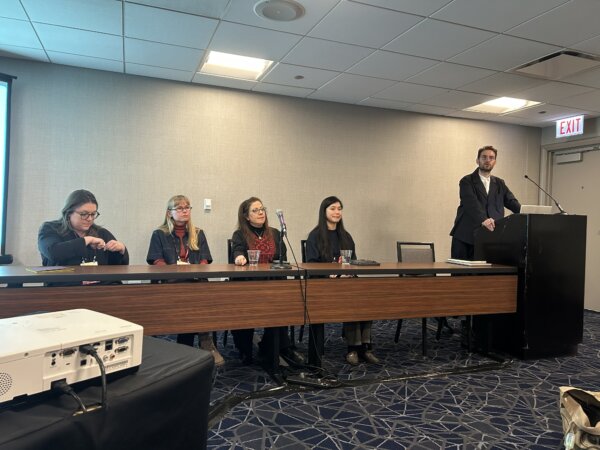
My paper, built on work I did during my bachelor’s thesis and facilitated by DHS’s gracious bursary, examined the gender division of labour in Joe Colombo’s capsule architecture. My paper (and other presentations like it including that of my fellow panel member Bahar Emgin and Evan Pavka’s presentation on Francis Gabe’s self-cleaning house) asked what happens when technology tries to solve or bypass problems of a more domestic nature. I grounded my analysis of Colombo’s conception of the gender division of labour in films that Colombo helped create showcasing his capsule habitat projects Visiona 1 (1969) and Total Furnishing Unit (1971-1972). I argued that Colombo’s practice was defined by a drive to design a technologically optimistic future in his present and to do so with the help of rigorous involvement from experts in diverse fields like sociology, psychology, and industry. Colombo believed in a realignment of the hierarchy present in modernist design toward one that prioritized design at the human scale over architecture or urban planning. He posited a vision of the domestic environment that radically shifted toward the future, untethering appliances from fixed positioning to be reconfigurable in space and time and facilitate experiences like remote work, telehealth, and digital nomadism.
However, using analysis of promotional films and exhibitions proposals as evidence, I argue that he did not articulate a restructuring of the modern gender division of labour. Instead, he tacitly acknowledged the traditional state of women as houseworkers or assumed the eventual elimination of housework via technological innovation rather than active engagement by the designer. Italian feminist Silvia Federici focused specifically on the issue of housework and co-founded the campaign Wages for Housework starting in the same year that Colombo’s Total Furnishing Unit was presented at MoMA. By putting Colombo’s films and proposals in conversation with Federici’s work from the same period and other histories of feminism in the period, I highlighted a blind spot in Colombo’s future thinking and questioned the ability of technosalvationism to solve social issues of the domestic environment without explicit social and critical engagement.
As a student researcher, I benefitted greatly from the conference and found the subject of uncertainty to be one that forces historians to ask how their work has a direct impact on the world around them. I met colleagues from across the field and the world, attended workshops that will help me as I prepare to publish in academic journals, and presented my work at an in-person conference for the first time. I was also able to read a copy of my first peer-reviewed article, an analysis and interview of Chinese furniture designer and amateur historian Kelvin Peng, published in a book by DHS and debuted at the conference. Overall, the conference was a formative experience that connected me with established and emerging scholars, broadened the horizons of my research, and grounded my interest in design history even as I study applied design practice. I am immensely grateful for the opportunity the bursary provided for me and I am already looking forward to seeing everyone again next year in London.
Categories
Contribute
Want to contribute to the blog and newsletter? Contact us
Newsletter
Keep informed of all Society events and activities, subscribe to our newsletter.