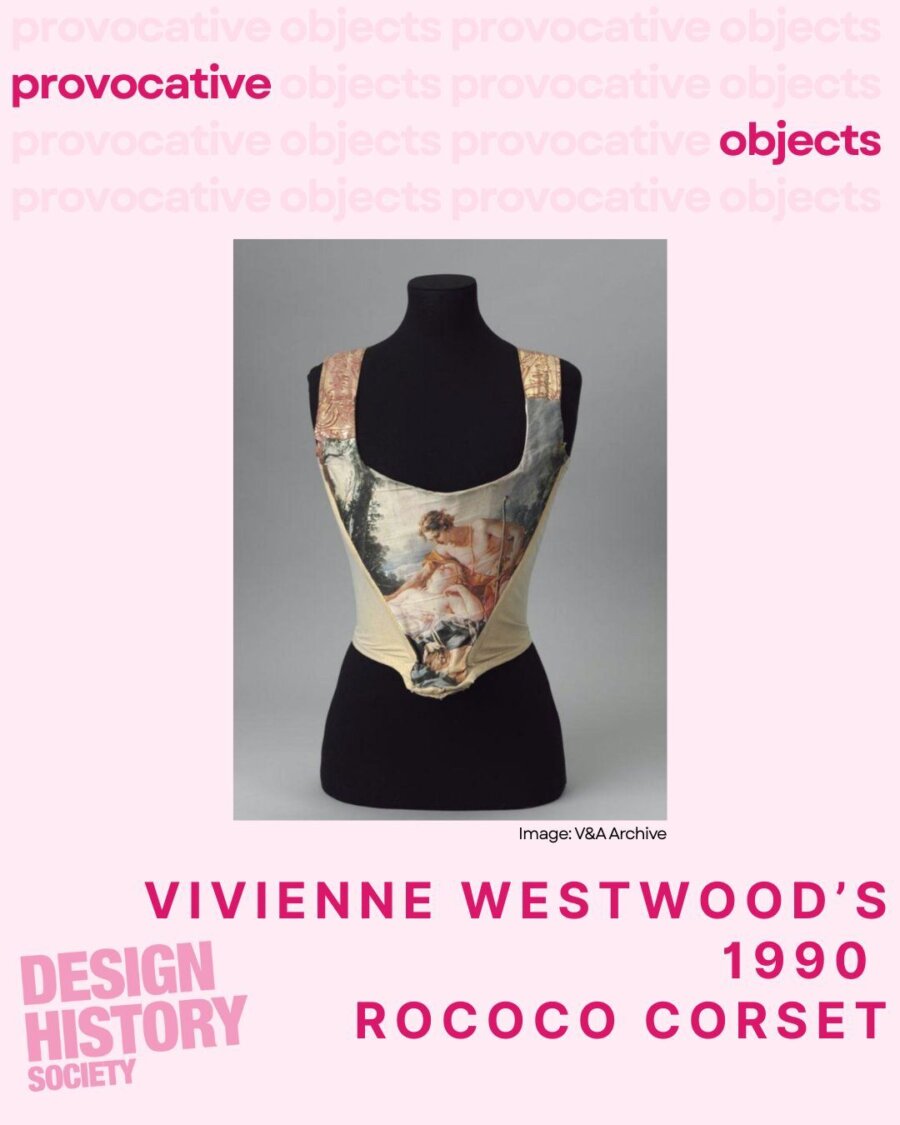
Vivienne Westwood’s 1990 ‘Portrait’ corset, printed with François Boucher’s Daphnis and Chloe, remains one of her most iconic designs, combining art history, eroticism, and political commentary into a single, sculptural silhouette (Figure 1). While it may appear to be a beautiful nod to Rococo indulgence, this corset, like so much of Westwood’s work, offers a deeper, more disruptive intent. It asks not only how we look at women, but who controls that gaze, and whether reclaiming historical forms can be an act of feminist resistance.
The corset itself, now held in the V&A, is based on the 18th-century whalebone stays worn by French aristocrats, re-engineered with stretch fabric, zip fastenings, and soft boning. The printed front features Boucher’s painting of a semi-nude shepherdess, Chloe, observed in slumber by her lover Daphnis. It’s a direct lift from the Wallace Collection, where Westwood often found inspiration. But in her hands, the painting, once hung passively on the salon wall, is now worn on the body, literally framing the chest of the wearer.
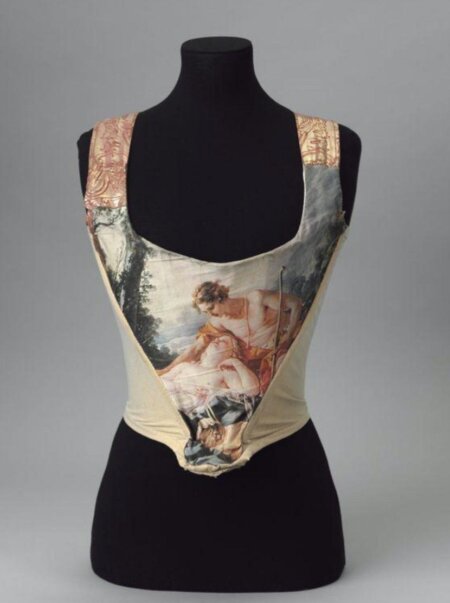
But this wasn’t Westwood’s first use of the corset. Long before she entered the world of couture, she had already been experimenting with its sexual politics in the punk and fetish scenes of 1970s London. In her boutique SEX, which she co-ran with Malcolm McLaren, Westwood sold bondage gear, rubber maid outfits, and early versions of fetish corsetry. These were garments designed to provoke: underwear as outerwear, latex against skin, straps and buckles worn defiantly in public. Her corsets are more about power by removing the garment from the privacy of the boudoir and placing it onto the public street.
She once remarked, “I’m always interested in seeing how far you can push people on a sexual level, fashion is about eventually becoming naked.” For Westwood, the corset was never just historical, it was also a political tool. Her early designs blurred the lines between fashion and fetish and between liberation and taboo.
This duality is what makes her 1990 Rococo corset so compelling. On the one hand, it draws from 18th-century aristocratic femininity: powdered wigs, oil paintings, and pastoral fantasies. On the other hand, it inherits punk’s confrontational energy and fetishwear’s unapologetic eroticism. It’s both salon and sex club; it’s with this tension that forms the core of the feminist debate:
Can corsets be feminist?
It’s a question that has long divided critics and designers alike. Historically, corsets have been symbols of patriarchal control, constricting, disciplining, and even damaging the female body. They were laced by servants, measured by men, and worn to display a woman’s social status or marriageability. From this perspective, reviving the corset might seem regressive; a romanticised return to oppression disguised as elegance.
But I believe Westwood flips this reading. By redesigning the corset for contemporary use, using zip closures, elasticated panels, and wearable fabrics, she removes its reliance on male control. Her corsets are donned by the wearer, not imposed by others. She once noted that stretch fabric “changes everything,” because now a woman could dress herself, adjust the fit, and move freely. This reclaims the silhouette not as punishment, but perhaps as expression, even armour.
Still, there’s no denying the corset’s complicated history. Even in Westwood’s hands, it elevates the breasts, sculpts the waist, and heightens femininity in ways that risk reinforcing traditional beauty ideals. Some feminist critics argue that eroticising these forms, even in play, can slide too easily into re-inscribing the gaze it claims to subvert. In that sense, the corset is both liberating and limiting, depending on who wears it and why.
Westwood, of course, embraced contradiction. Her feminism was never prescriptive. She didn’t want to erase femininity to be empowered, she wanted to rewrite its rules. She controversially said in the early ‘90s, “I’ve never thought it powerful to be like a second-rate man. Femininity is stronger.” (Though it sounds controversial now for entirely different reasons!) Through her corsets, she constructed a form of femininity that was sexual, intellectual, and sovereign. In fusing the eroticism of Rococo art with the politics of punk and the aesthetic codes of fetishwear, she reimagined what female empowerment could look like.
The 1990 ‘Portrait’ collection, where this corset debuted, was critically celebrated and commercially successful. The press described it as a turning point in Westwood’s career. British Vogue featured it extensively, and the corset became a studio test piece for her pattern-cutters.
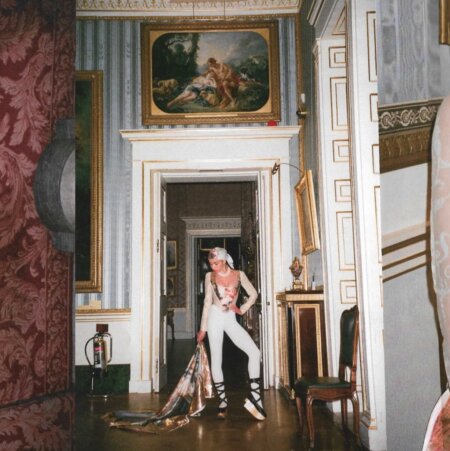
Today, the Boucher corset continues to inspire. Whether worn by celebrities like Bella Hadid and FKA twigs or displayed in major retrospectives, it remains a symbol of how fashion can be both political and sensual. It doesn’t resolve the corset debate, but it ensures it continues (Figure 2).
Perhaps that’s what Westwood wanted: not a simple answer, but a more complex kind of freedom.
Sufiyeh Hadian is a fashion and design historian whose work explores feminist cultural histories through objects, archives, and visual storytelling.
Started by the DHS Ambassadors in 2022, the Design History Society’s Provocative Objects and Places blog series looks at spaces and objects that challenge and confront us as design historians.
Past topics have ranged from the ancient Colosseum in Rome to the ultramodern Antilia in Mumbai; pink razors and Barbies to Lalique’s Bacchantes vase and nineteenth-century asylum photography. The full collection of previous posts can be found here: https://www.designhistorysociety.org/blog/category/provocative-objects-spaces
We invite submissions for guest blog posts from students, early career researchers, and established academics to those with a general interest in design history. Post can be on any object or place from any era, anywhere in the world, which in some way incites discussion and debate. Post should be 500-800 words in length, accompanied by at least one image with associated credits and clearances, and a short bio.
Please send to the DHS Senior Administrator, Dr Jenna Allsopp designhistorysociety@gmail.com
Categories
Contribute
Want to contribute to the blog and newsletter? Contact us
Newsletter
Keep informed of all Society events and activities, subscribe to our newsletter.