On the black floor, a small gold‐coloured dress lies utterly still, suspended between flowers, jewellery, and devotional relics. Its pleats – stiffened by time, by ritual, by the weight of centuries – rise gently from the fabric, as if remembering the shape of the body that once filled it. The garment, a burial dress worn by a three‐year‐old girl in seventeenth‐century Sweden, mimics the absent form beneath it without ever revealing it. It gestures toward a body while refusing to conjure one. A dress that performs presence through absence.
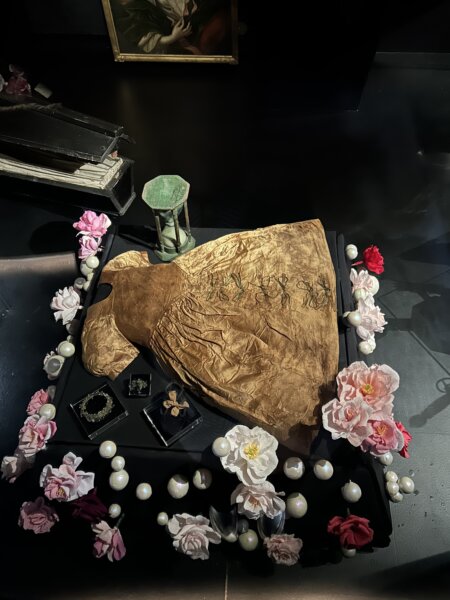
Seen like this – flat, unanimated, uninhabited – the dress becomes more than a historical artefact. It becomes a provocation. It asks why some garments in museums are granted bodies, while others are denied them. It asks what it means to display clothing without the architecture of a mannequin, and what kinds of bodies mannequins quietly assume when they are present. What work does the mannequin do in shaping how we imagine, normalise, and discipline bodies in museum space?
Mannequins are often treated as neutral display tools – the backstage infrastructure of fashion exhibitions. Yet they are profoundly designed objects, calibrated to particular ideals of proportion, posture, and legibility. They are, in Judith Butler’s terms, technologies of performativity: they materialise a normative body so that garments can appear “natural” upon it. Their neutrality is a fiction. A mannequin is never just a mannequin; it is a proposition about who the imagined wearer is. (1)
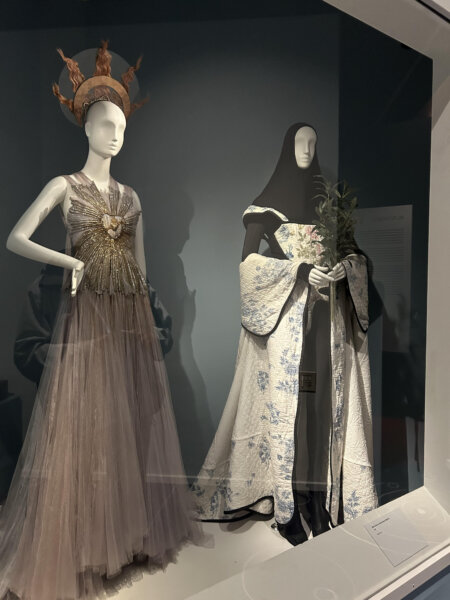
The burial dress exposes this fiction with startling clarity. A mannequin would be impossible here – too embodied, too alive, too literal. Its absence reveals the mannequin’s usual presence as a structuring force. As Sara Ahmed argues, objects orient us: they shape how bodies take shape in space, how they are anticipated, how they are read. (2) The mannequin is one such orienting device. It tells us what kind of body belongs in a garment, and by extension, what kind of body belongs in the museum.
Fashion scholars such as Christopher Breward and Joanne Entwistle have long argued that dress is relational – always in dialogue with the body. (3) But the mannequin mediates this relationship. It stands in for the absent wearer, but it does so selectively. Most mannequins reproduce a narrow spectrum of bodies: slim, upright, proportionally balanced, implicitly white, implicitly adult. They are bodies without history, without vulnerability, without contingency. They are bodies that do not die.
This is why the burial dress is so arresting. It resists the mannequin’s smoothing function. It refuses to be animated by a standardised form. Instead, it lies in a posture of stillness that museums rarely allow. In doing so, it exposes the mannequin as a disciplinary tool in the Foucauldian sense – a device that normalises, regulates, and makes certain bodies visible while rendering others unthinkable. (4)
The absence of a mannequin also shifts the dress from fashion object to material culture artefact. It becomes closer to what Amiria Henare and colleagues call a “theory object”: something that does not merely illustrate an argument but generates one. (5) The dress, precisely because it is not worn, not filled, not upright, becomes a site for thinking about the politics of display.
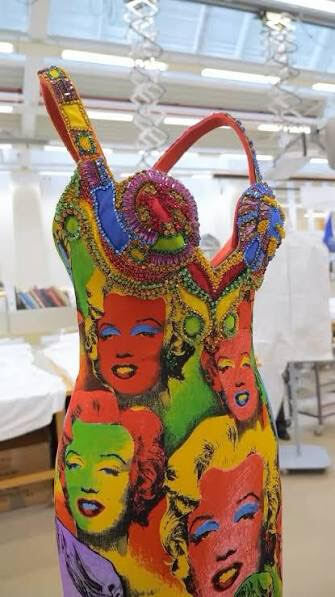
It also reveals the choreography embedded in mannequins. In many fashion exhibitions,mannequins operate as silent authors. They script how garments are read: the tilt of a hip suggests nonchalance; a forward lean implies modernity; a rigid spine signals historical distance. Even the colour of the mannequin – matte black, glossy white, translucent resin – shapes the interpretive frame. These choices are rarely acknowledged, yet they structure the visitor’s experience as much as the garments themselves.
The burial dress, by contrast, refuses choreography. It cannot be posed. It cannot be made to perform. Its flatness is a refusal – and in that refusal, it reveals the mannequin’s power. Perhaps this is the provocation: that the most revealing mannequin is the one that is not there. The absence forces us to confront the assumptions embedded in the bodies we do see – the bodies museums deem appropriate, legible, displayable. It invites us to imagine alternative mannequins: bodies that sag, bodies that age, bodies that grieve, bodies that do not conform to the smooth geometry of display.
And so the small gold dress continues to lie there, pleats rising like a quiet breath. A garment without a body, yet full of bodies – the ones we expect, the ones we erase, the ones we have not yet learned to see. In its stillness, it whispers a simple question: what kinds of bodies do our museums allow to exist?
References
1 Judith Butler, Bodies That Matter: On the Discursive Limits of “Sex” (New York: Routledge, 1993).
2 Sara Ahmed, Queer Phenomenology: Orientations, Objects, Others (Durham: Duke University Press, 2006).
3 Christopher Breward, The Culture of Fashion (Manchester: Manchester University Press, 1995); Joanne Entwistle, The Fashioned Body (Cambridge: Polity Press, 2000).
4 Michel Foucault, Discipline and Punish: The Birth of the Prison (New York: Vintage Books, 1977).
5 Amiria Henare, Martin Holbraad, and Sari Wastell, eds., Thinking Through Things: Theorising Artefacts Ethnographically (London: Routledge, 2007).
Lieke Penders is a curator and design researcher with a background in fashion, design, and decorative arts. She holds a Master’s degree in Design Cultures from the Vrije Universiteit in Amsterdam. Currently based in Stockholm, she works for a gallery specialising in historically significant design, and as a freelance writer and researching, with an interest in how (fashion) design shapes and mediates cultural meaning, authorship and temporality.
Started by the DHS Ambassadors in 2022, the Design History Society's Provocative Objects and Places blog looks at spaces and objects that challenge and confront us as design historians. We invite submissions for guest blog posts from students, early career researchers, and established academics to those with a general interest in design history. Posts can be on any object or place from any era, anywhere in the world, which in some way encourages discussion and debate. Posts should be 500-800 words, accompanied by at least one image with associated credits and clearances, and a short bio. Please contact the DHS Senior Administrator, Dr Jenna Allsopp-Douglas for more information.
Categories
Contribute
Want to contribute to the blog and newsletter? Contact us
Newsletter
Keep informed of all Society events and activities, subscribe to our newsletter.