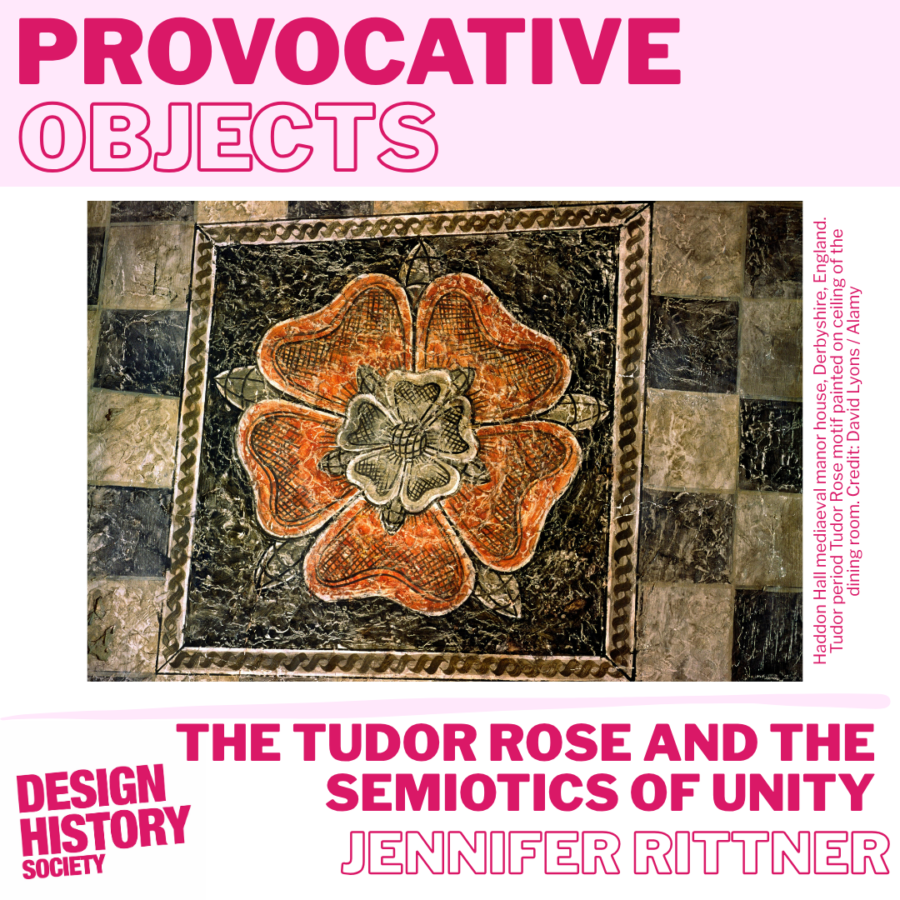

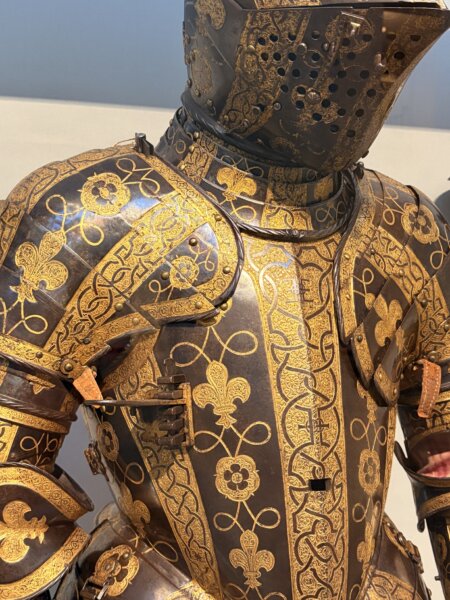
Most frequently recognized as a symbol of love, beauty, and fertility, the stylized rose (Figure 1) has also emblematized an ancient family beset by disunity and strife. When the Plantagenets instigated a multi-generational, dynastic feud that eventually came to be known as the War of the Roses, each faction adopted a colored rose to symbolize their side. The white rose appeared early and often as the badge of the York clan (Figure 2) and, late in the feud, Henry Tudor adopted the red rose to rally the Lancastrian cause. Applied to badges, banners, and armor in order to signal the wearer’s loyalties to one or the other family, the rose became, in the 15th century, a symbol of war; and in its ultimate fusing as the Tudor rose, a signal that unity could be achieved through the embodied politic of a King and his wife. The semiotic choice of color and form formed a legible device through which the monarch clarified, however apocryphally, nearly a century of strife in one viscerally poignant – to a traumatized citizenry and a skeptical nobility - visual narrative that became the enduring story of the time.
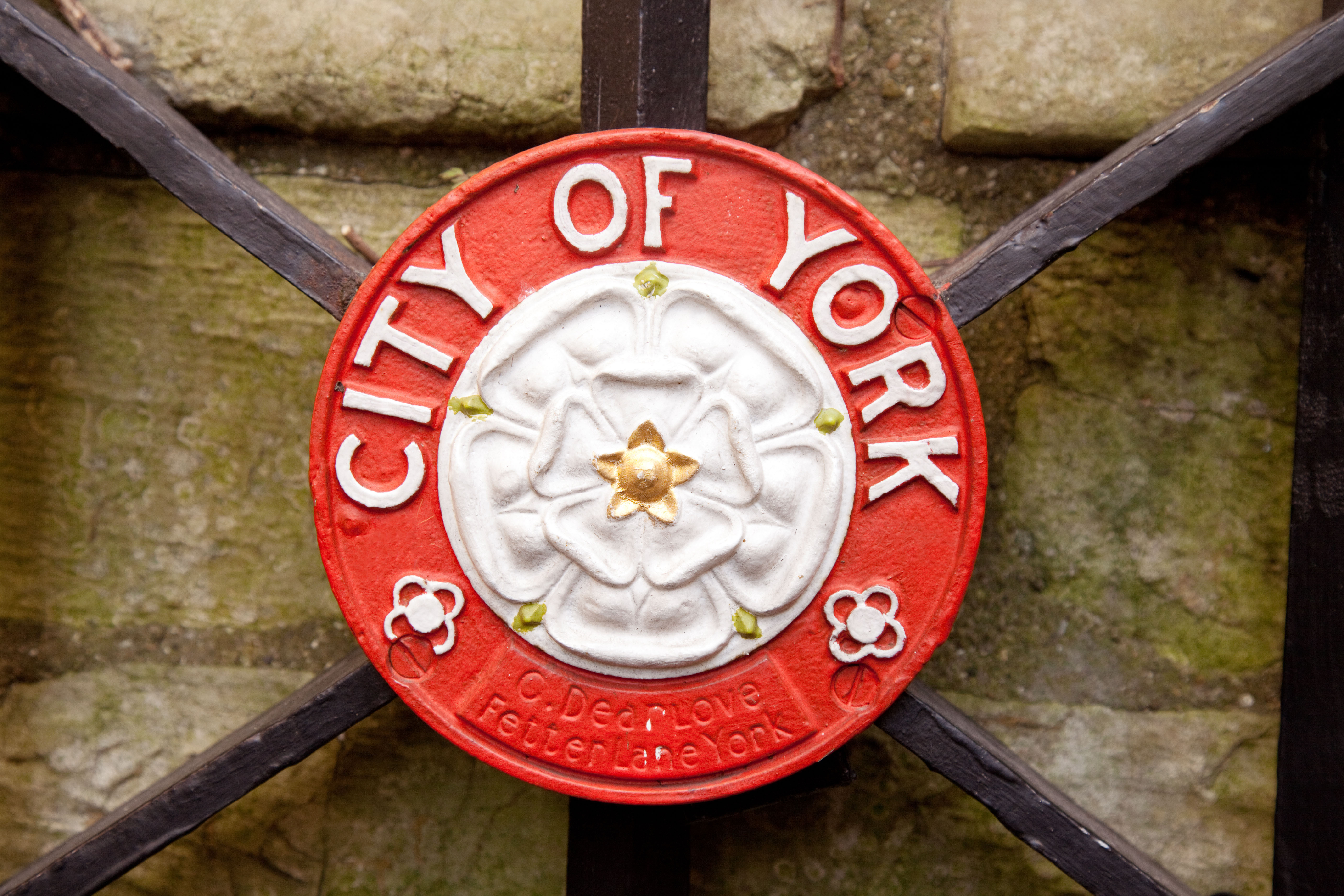
Credit: Kumar Sriskandan / Alamy
Lasting the better part of a century, the internecine war extinguished tens of thousands of lives; and when the bloodshed finally ended, a unified kingdom became personified by the Tudor Rose. The visual design encapsulates two nested identities, reliant on each other, symbiotic, collective, and protective - the white Yorkist flower tucked delicately inside a red Lancastrian one to form a single bloom. To the modern eye, it is a decorative antique; but to the semiotician, it is a masterclass in the art of symbolizing unity without demanding erasure.

There are many ways to read the symbol: the interior white rose as the womb, which is certainly apt as Elizabeth of York’s role would be to produce heirs of the realm, and the exterior red rose as a crown in the regnal body of Henry VII. One might interpret the white rose as imprisoned by the forces of Lancastrian red that surround it, demanding submission. Perhaps one can see a white rose shrinking as the red rose expands its power around and beyond it.
But we might also choose to read the Tudor rose as the embodiment of leadership and sacrifice. Through leadership, we read the strength to find common ground and instigate unity. In sacrifice, respectful deference to its newly conjoined other and a willingness to forgo anger, outrage, or retribution. The Tudor rose is not a melding rather, it is a new organism, with each part distinguishable to its representatives, while honoring and embodying the even greater beauty they produce together.
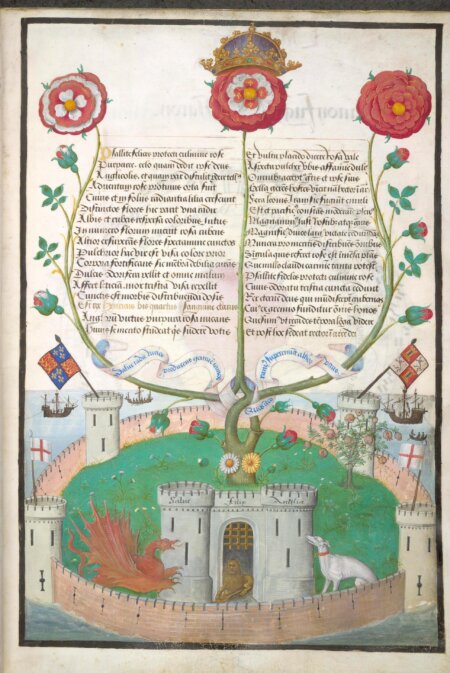
Powerful imagery can catalyze a movement and it can also re-write history. Henry Tudor may have invented the significance of the red rose for the Lancasters in order to place himself within the frame of a dynastic story. According to historian Dan Jones the red rose was an apocryphal invention proffered after 1485:
“as a counterpoint to the white [rose], puffing up the weak Tudor claims to royal legitimacy . . . as king, Henry VII had his scribes, painters, and librarians plaster documents with red roses - even going so far as to modify books owned by earlier kings . . .”(1)
The symbol was not the act of unity but its power of persuasion helped to make sense of decades of violence and destruction. A century after the wars, William Shakespeare seized on Tudor’s semiotic sleight of hand in his historical play of the life of Henry VI, through which he imagines the scions of York and Lancaster choosing their roses from a garden, followed by armies of men wearing them proudly into battle to honor their allegiances (Part 1; Act II, Scene IV, 29-38).
Apocryphal but legible, the symbolism endured in part because it simplified a much more complex reality. Notably, Henry did not choose as his emblem a dragon, leopard, or boar, but a symmetrical object that could make possible the unified state. A tale of two roses simplifies the narrative, and romanticizes it. It renders the legacy palatable and, perhaps even, inevitable.
Historian Frederick Hepburn reflects on the salience of visual symbolism, writing:
“. . . visual images of those who hold power are an important factor in the relations between rulers and people. Pictures . . . persuade; and we know that the right image, chosen with care, can be a key element in enabling a leader, or a would-be leader, to gain popular acceptance.”(2) (Hepburn, 2019)
Today, symbols of factional identity abound while those of unity remain elusive. Black Lives Matter flags, rainbow buttons, MAGA hats, Proud Boys patches, the AIDS ribbon. These express resistance, individuation, hate, and healing. They are personal and profound manifestations of social belonging, developed out of pride, fury, and often as a demand for acknowledgement and action. What, though, are the symbols that offer us hope for unity? What acts of genuine leadership and sacrifice will precede their invention?
The semiotics of unity are not the end of warfare. They do not make us whole. But they can provide a view of our nested reality with the power to change how we see ourselves and each other, and reflect the reality that, like the warring clans of early Renaissance England, we only thrive when we see ourselves as one.
Footnotes
(1) Dan Jones, The Wars of the Roses: The Fall of the Plantagenets and the Rise of the Tudors, 2015, p7
(2) Frederick Hepburn, Emblems of Monarchy: Royal Portraiture in Yorkist and Early Tudor England, 2024, vii
Bibliography
Craig, M.A., W. J. The Complete Works of William Shakespeare. 1905; London: Oxford University Press, 1957.
Halder, Jacob. Armor Garniture of George Clifford (1558-1605), Third Earl of Cumberland. 1586. Steel, gold, leather, textile.
Hepburn, Frederick. Emblems of Monarchy: Royal Portraiture in Yorkist and Early Tudor England. London Turnhout: Harvey Miller Publishers, 2024.
Jones, Dan. The Wars of the Roses: The Fall of the Plantagenets and the Rise of the Tudors. New York, N.Y: Penguin Books, 2015.
Lyon-Whaley, Susannah, ed. Floral Culture and the Tudor and Stuart Courts. Early Modern Court Studies. Amsterdam: Amsterdam University Press, 2024.
McKendrick, Scot, Kathleen Doyle, and British Library, eds. Royal Illuminated Manuscripts: From King Athelstan to Henry VIII; [on the Occasion of the Exhibition at the British Library “Royal Manuscripts: The Genius of Illumination”, 11 November 2011 - 13 March 2012]. 1. publ. London: British Library, 2011.
Slater, Stephen. The Complete Book of Heraldry: An International History, Sourcebook, and Visual Encyclopedia. United Kingdom: Anness Publishing Ltd, 2023.
Weir, Alison. Eleanor of Aquitaine: A Life. Ballantine Books, 2008.
Weir, Alison. Elizabeth of York: A Tudor Queen and Her World. Ballantine Books, 2014.
Weir, Alison. The Wars of the Roses. New York: Ballantine Books, 1995.
Jennifer is Assistant Professor of Strategic Design and Management and Associate Dean of Curriculum and Pedagogy at Parsons School of Design. Her research investigates critical thinking in design pedagogy. As Assistant Curator of Education at the American Federation of Arts (AFA) in the 1990s, Jennifer led Art Access II, an initiative designed to increase museum attendance among under-served communities. She earned her B.A. in Education at New York University and her M.Ed. in Communication and Education at Columbia University.
Started by the DHS Ambassadors in 2022, the Design History Society's Provocative Objects and Places blog looks at spaces and objects that challenge and confront us as design historians. We invite submissions for guest blog posts from students, early career researchers, and established academics to those with a general interest in design history. Posts can be on any object or place from any era, anywhere in the world, which in some way encourages discussion and debate. Posts should be 500-800 words, accompanied by at least one image with associated credits and clearances, and a short bio. Please contact the DHS Senior Administrator, Dr Jenna Allsopp-Douglas for more information.
Categories
Contribute
Want to contribute to the blog and newsletter? Contact us
Newsletter
Keep informed of all Society events and activities, subscribe to our newsletter.