The history of art and design contains countless examples of women’s work being attributed to men(1). One object in the Cooper Hewitt Smithsonian Design Museum’s collection reverses this narrative. For more than fifty years, both a chair and table were attributed to the prolific American interior decorator Elsie de Wolfe (Lady Mendl), until archival research I conducted in April 2025 revealed new evidence that challenged one of these longstanding claims.
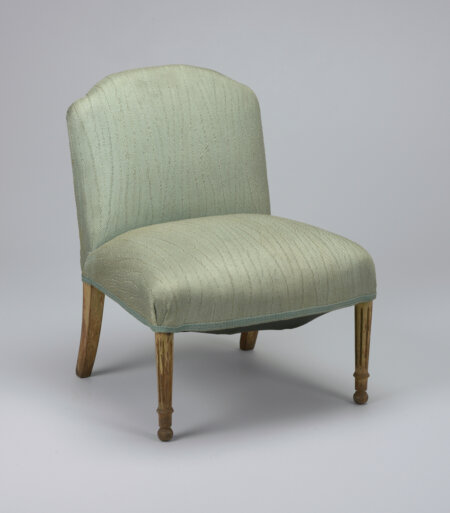
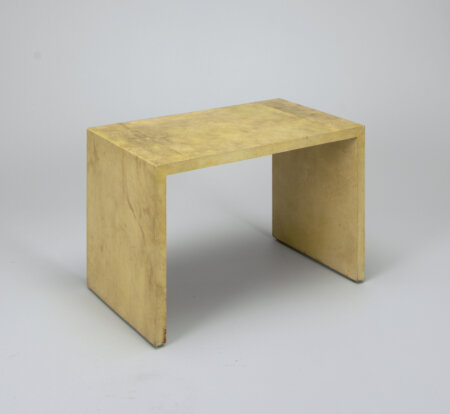
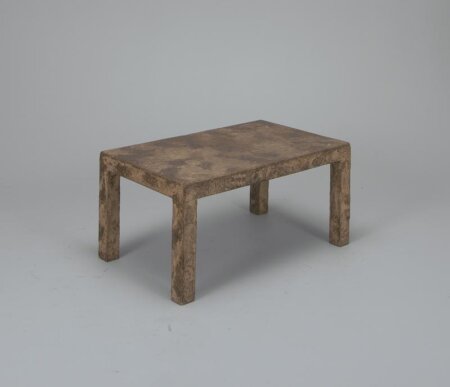
The two objects in question bore noticeable visual and material differences. The low-slung Louis XVI-style slipper chair with its pickled wood finish, antique silk upholstery, and soft edges [Figure 1] sat comfortably within de Wolfe’s decorative ethos, which drew heavily from eighteenth-century French aristocratic interiors(2). By contrast, the parchment-covered coffee table [Figure 2] was angular and minimalist in its construction, stylistically akin to French Art Deco furniture of the late 1920s and early 1930s. Although de Wolfe’s later interiors embraced aspects of the moderne style—incorporating materials such as Lucite alongside bold accents like leopard-print upholstery—the table represented a significant departure from her established decorative vocabulary.
When placed side by side in the Cooper Hewitt archives, the contrast between the two objects became impossible to ignore. With the assistance of Associate Curator Emily Orr, the museum’s accession records offered a plausible explanation for the association with de Wolfe. Both objects entered the collection through Rodman A. Heeren, whose mother, Fernanda Wanamaker (later Mrs. Ector Munn), was a close friend, collaborator, and client of de Wolfe’s. Museum records identified the chair as having been designed by de Wolfe in the 1920s for Mrs. Munn’s boudoir at her residence at 17 East 90th Street in New York City(3). Although no photographs of the chair are known to exist before its accession into the museum’s collection in 1970, its documented provenance and stylistic consistency with de Wolfe’s oeuvre support the attribution.
The table, however, proved less convincing. Donated two years prior by the same Mr. Heeren, the table is described in the museum’s records as having been designed by de Wolfe around 1930. During a visit to the Heeren’s home—the same residence at 17 East 90th Street associated with Mrs. Munn—former Cooper Hewitt director Richard P. Wunder noted the table and requested its donation, along with a previously promised vase and planter. This request was documented in correspondence between Hereen’s assistant, Malcolm Valance, and the museum’s administrator, Christian Rohlfing, who wrote: “At the same time we saw a small table covered in parchment designed by Lady Mendl […] We wish to have this piece, too, for it supplements other objects in the collection from early in the twentieth century.”(4) The attribution appears to have entered the museum’s records through this correspondence, without thorough examination of the object nor independent verification of de Wolfe’s authorship.
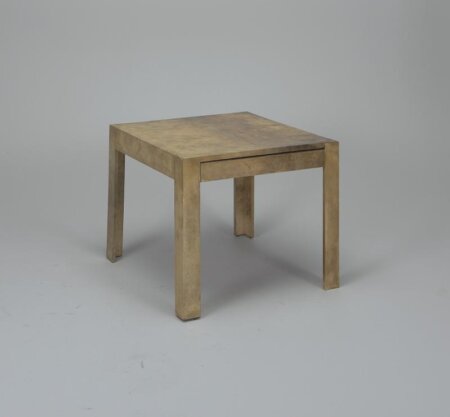
The attribution became even more curious when considered alongside other objects already in the museum’s collection. The table aligned with a similar grouping of furniture—including desks and chairs of comparable material and stylistic character—recently acquired by the museum from Mr. William Forsythe Sherfesee and his wife Emily [Figures 3 and 4](5). These ‘similar’ objects were securely attributed to Jean-Michel Frank, the French interior designer and Art Deco pioneer of the 1920-30s, who had outfitted residences for the Sherfesees(6). Despite the remarkable similarities between Frank’s existing work and the table donated by the Heerens, this connection was never investigated further.
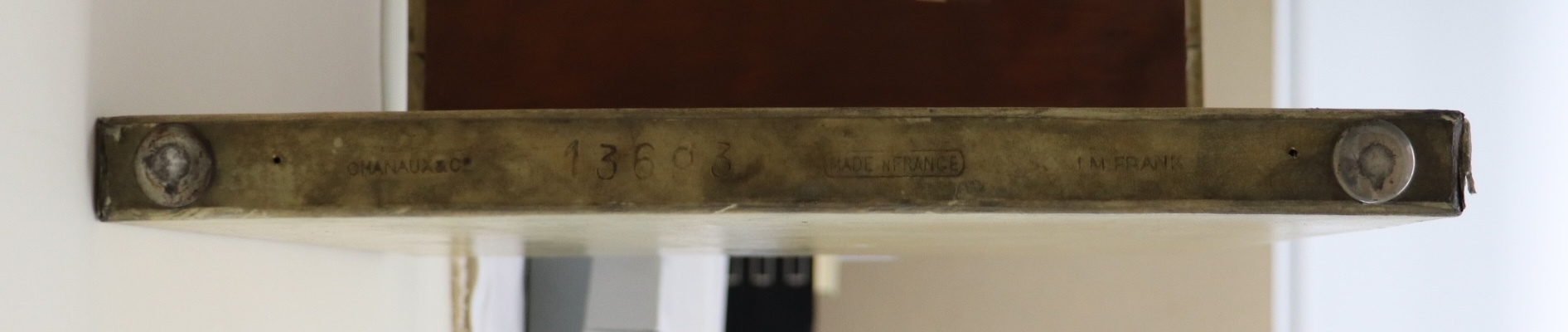
The decisive evidence was hidden beneath the table’s leg. Closer examination revealed previously undocumented inscriptions: “Chanaux & Co.,” “Made in France,” and “J. M. Frank” [Figure 5]. Together, they identified the workshop, the place of manufacture, and the designer, leaving little doubt that the table was the work of Frank rather than de Wolfe. Even so, this reattribution does not necessarily sever the table’s connection to de Wolfe. Given her established connection to Mrs. Munn’s interiors, it remains possible that the decorator selected the table for the family’s longtime New York residence. If so, the object’s association with de Wolfe reflects not its authorship but its place within one of her commissions—a distinction that may have blurred over decades of family history before entering the museum’s collection.
Rather than simply correcting an attribution, this discovery invites a more nuanced understanding of authorship, one that accommodates the often-overlapping roles of decorator and designer. As a pioneer in the decorative profession, de Wolfe was celebrated for composing complete interiors, sourcing antiques and commissioning modern reinterpretations of historical styles, rather than designing or making furniture herself. Recognizing this distinction allows the table to occupy two complementary histories: one as a work of furniture design by Frank, and another as part of an interior conceived by de Wolfe. Rather than diminishing either figure’s contribution, the reattribution clarifies the distinct roles each played in shaping the modern interior.
References
Cheryl Buckley, “Made in Patriarchy: Toward a Feminist Analysis of Women and Design,” Design Issues 3, no. 2 (1986): 3–14.
Penny Sparke, Elsie de Wolfe: The Birth of Modern Interior Decoration (New York: Acanthus Press, 2005).
Malcom Valance, “Letter to Christian Rohlfing, November 3,” 1970, Registrar Files, Cooper Hewitt Smithsonian Design Museum.
Christian Rohlfing, “Letter to Malcom Valance, December 20,” 1968, Registrar Files, Cooper Hewitt Smithsonian Design Museum.
Sarah D. Coffin, “Surface of Luxury,” Cooper Hewitt Smithsonian Design Museum, July 19, 2017, https://www.cooperhewitt.org/2017/07/19/surface-of-luxury/.
Laure Verchère, Jared Goss, Julie Blum, François Baudot, and Assouline, Jean-Michel Frank (New York: Assouline, 2018).
Sara Shields-Rivard (she/her) is a Ph.D. candidate in Art History at Queen’s University (Canada), whose doctoral research highlights women artist-designers and feminist interventions in design history. Her dissertation revisits the gendered and racial implications of Elsie de Wolfe’s life and decorative work, situating her practice through the transnational contexts of the places she lived and travelled—Canada, the United States, France, and India—and through her connections to other creative women, including Elsa Schiaparelli and Princess Sita Devi of Kapurthala. Her research on this topic was published in Lisa Binkley’s Dwelling at the Margins of Empire: Global Perspectives of Home (Bloomsbury, 2025).
Started by the DHS Ambassadors in 2022, the Design History Society's Provocative Objects and Places blog looks at spaces and objects that challenge and confront us as design historians. We invite submissions for guest blog posts from students, early career researchers, and established academics to those with a general interest in design history. Posts can be on any object or place from any era, anywhere in the world, which in some way encourages discussion and debate. Posts should be 500-800 words, accompanied by at least one image with associated credits and clearances, and a short bio. Please contact the DHS Senior Administrator, Dr Jenna Allsopp-Douglas for more information.
Categories
Contribute
Want to contribute to the blog and newsletter? Contact us
Newsletter
Keep informed of all Society events and activities, subscribe to our newsletter.