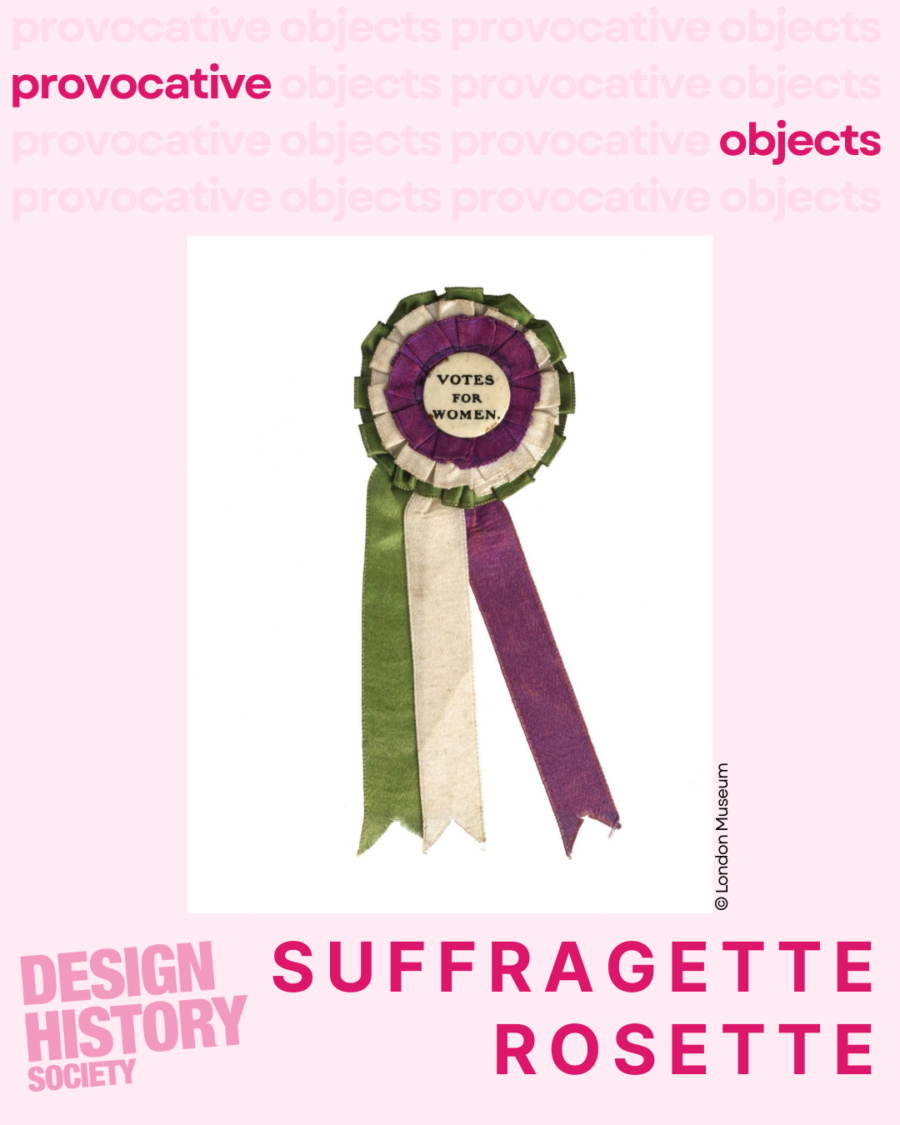
Amongst the most quietly radical objects in the history of British feminism is the suffragette rosette. Modest in scale yet deliberate in design, it functioned as one of the earliest examples of political identity made visible through dress. Long before feminist protest became associated with placards or slogans, the rosette offered a subtler, more pervasive form of dissent: one that could be worn, repeated, and recognised.
The rosette emerged in 1908 under the auspices of the Women’s Social and Political Union (WSPU), the suffrage organisation founded by Emmeline Pankhurst. Its now-iconic tricolour palette; purple, white and green, was devised by Emmeline Pethick-Lawrence, then co-editor of Votes for Women. Each colour carried symbolic intent: purple for dignity and loyalty, white for purity, green for hope. Together, they formed a coherent visual language that could be instantly read by supporters and opponents alike.
Visual Identity as Political Infrastructure
The suffrage movement understood that political change required visibility as much as rhetoric. In an era when women were largely excluded from formal political spaces, dress became a crucial site of expression. The rosette allowed suffragettes to occupy public space visibly, persistently, and collectively.
Pinned to hats, stitched into sashes, or fashioned into badges, the rosette transformed the female body into a mobile site of protest. It offered a way for women to signal allegiance to the cause in daily life, blurring the boundary between activism and the everyday. In doing so, it created a distributed form of political participation: one that extended beyond demonstrations and into the fabric of the city.
Surviving examples of suffragette rosettes, many preserved today in institutions such as the Museum of London, attest to the care with which these objects were produced. Often bearing slogans such as Votes for Women, they combined colour, text and form to produce a compact yet potent political artefact.
Commerce and the Cause
Notably, suffragette rosettes were not confined to activist circles alone. They were sold commercially through prominent London department stores, including Liberty, marking an early convergence of feminism, fashion and retail. Ribbons, belts and accessories in suffragette colours circulated widely, enabling women to materially align themselves with the movement regardless of their capacity for direct action.
This commercial availability has sometimes been read retrospectively as a dilution of political seriousness. Yet within its historical context, it functioned differently. Rather than neutralising the message, it expanded it. The ribbon’s reproducibility allowed suffrage symbolism to proliferate, embedding the movement’s presence across class lines and social spaces.
Crucially, these objects amplified activism, creating a visual continuity that linked individual supporters to a collective struggle, making the movement harder to ignore and easier to recognise. More than a century later, the suffragette rosette remains a compelling museum object, encapsulating a formative moment in feminist history when politics, design and daily life were consciously interwoven. It reminds us that movements are sustained through repetition, visibility and shared symbols.
Sufiyeh Hadian is a fashion and design historian whose work explores feminist cultural histories through objects, archives, and visual storytelling.
Image copyright holder:
digital image © London Museum
Category: Fashion
Object ID: 77.166/6
Object name: rosette
Production date: 1908-1912
Material: textile, tin
Measurements/duration:
H 150 mm, DM 58 mm (overall)
https://www.londonmuseum.org.uk/collections/v/object-87712/rosette/
Started by the DHS Ambassadors in 2022, the Design History Society's Provocative Objects and Places blog looks at spaces and objects that challenge and confront us as design historians. We invite submissions for guest blog posts from students, early career researchers, and established academics to those with a general interest in design history. Posts can be on any object or place from any era, anywhere in the world, which in some way encourages discussion and debate. Posts should be 500-800 words, accompanied by at least one image with associated credits and clearances, and a short bio. Please contact the DHS Senior Administrator, Dr Jenna Allsopp-Douglas for more information.
Categories
Contribute
Want to contribute to the blog and newsletter? Contact us
Newsletter
Keep informed of all Society events and activities, subscribe to our newsletter.