The Design History Society's student travel award allowed me to spend several weeks in Paris in November-December 2014 to undertake final research before I submit my PhD thesis in 2015 to the Courtauld Institute of Art. This trip, which followed three years of research and writing, served to verify information as well as find new sources at institutions such as the Bibliothèque Nationale de France and Institut national d'histoire de l'art.
My thesis, titled, “Constructions of Modernity, 1950-1970: Prêt-à-Porter, Paris, and the Image of Women,” studies the French ready-made clothing industry against the cultural stage of the Fourth and Fifth Republics, during which time the country struggled to redefine itself in relation to shifting ideas of modernity. France's construction of modernity during this period was informed by transitions, into new economic and industrial systems, decolonised and urbanised landscapes, and by its perceived loss of political and cultural hegemony. Modernity also comprised contradiction—between prosperity, modernisation and tradition—and tension, felt by the individual in a mass culture and by women in their ambiguous status as citizens. Each chapter considers how fashion related to complex notions of modernity with regard to different aspects of the clothing industry, from shifting visualisations and symbolic constructions of women and Paris in the fashion press to promotional methods and language, production, distribution, and reception. It asks how players from disparate fields—industry, government, and art—used fashion to negotiate national and gender identity and modernity in various ways. My thesis thus considers how fashion, through the study of extant garments, pictured and written clothing, oral history, fine art, literature, film, and other commentary, related to its wider cultural landscape.
Many historical studies consider the 1960s as the moment of revolution and democratization that allowed ready-to-wear to develop. To challenge romanticizing narratives, I study the industry of the 1950s, and contextualise it against the postwar political and economic arena. One aspect of my research looks at Productivity Missions taken by the French ready-to-wear industry to the United States in the context of the Marshall Plan. During this research trip I consulted records of these missions at the Archives Nationales. This provided insight into how the clothing industry was viewed as a key factor in the French international economy, the Franco-American dialogue, and tool of modernisation.

Dépêche Mode, October 1967, no. 624
French industrialists realised that clothing could also be used as cultural capital and as a tool in shaping national identity. The promotion of Les Trois Hirondelles, a label and grouping of different French ready-to-wear brands assembled by the Association des Maisons de Couture en Gros, attests to these ideas. During my Paris trip I was able to view a book of fashion illustrations and fabric samples by Jean-Pierre Gattegno, a manufacturer who belonged to Les Trois Hirondelles, at Paris' Musée Galliera. This object provided valuable information concerning production. I also interviewed Jean-Claude Weill, who was in charge of the ready-made company Maison Weill during the 1950s. This company took part in USA missions and made important, early attempts at publicity at this time, and I was very fortunate to have heard his first-hand commentary.

Weill catalogue, Spring-Summer 1963
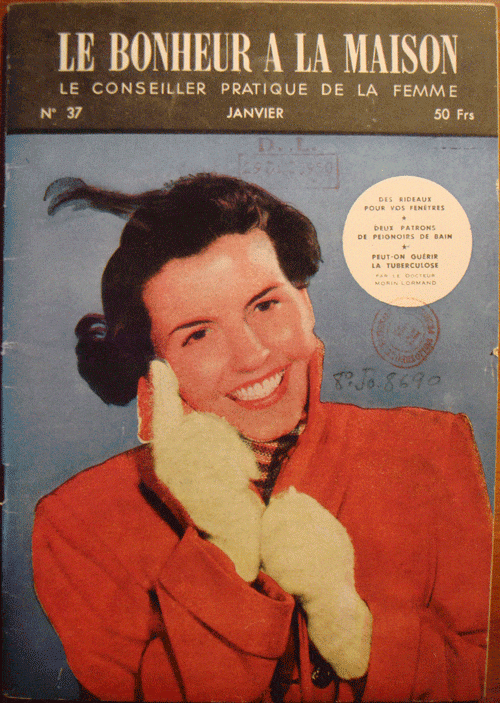
Much of my thesis is based on analysis of the fashion and feminine press. At the Bibliothèque Forney I consulted several women's magazines for the first time, including issues of Modes de Saison, Je m'habille, Modes et Travaux, Modes de Paris, and Bonheur à la Maison from the late 1940s and 1950s. Studying these publications, which focused on lifestyle (and its materiality and visualisation), added a new perspective to this earlier period. The increasing concentration on ready-to-wear brands in these pages throughout the course of my studied period was evident. At the end of the research trip I interviewed journalist Ginette Sainderichin, who was involved in the creation of Groupe Avant-Première, a publication that sought to synchronise the trade and fashion press in terms of ready-to-wear collections. The need for this type of publication spoke to the change in the fashion landscape that the earlier lifestyle magazines illustrated.
The majority of my research considers image and representation, and in addition to magazine imagery, during this trip I studied photographs of women and Paris spaces by photographers including Janine Niepce and Jean Marquis, held at the Bibliothèque Historique de la Ville de Paris. A final, vital goal of this trip was to undertake oral histories of women who spent the 1950s and 1960s in France in their twenties and thirties. This first-hand commentary provided fascinating contrast to my image analysis. Through interviews focusing on women's dress and experience, I sought to link object to memory, personal to wider history, and explore the emotional and figurative aspects of dress. The oral histories were an invaluable addition to my thesis, which seeks to rethink French, women's, and fashion histories.
Categories
Contribute
Want to contribute to the blog and newsletter? Contact us
Newsletter
Keep informed of all Society events and activities, subscribe to our newsletter.