8 October, 2025
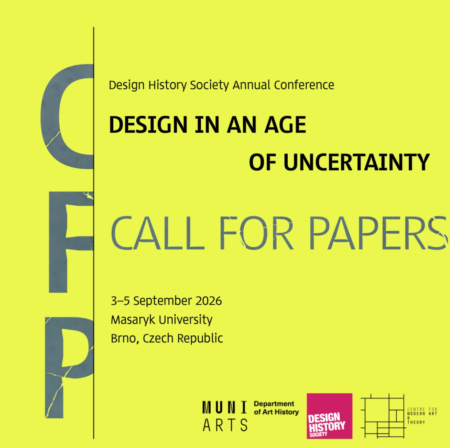
We create, research, and teach in an age of uncertainty driven by war, mass migration, and climate change.
In 2019, Nancy Fraser invoked Gramsci’s dictum that “the old is dying and the new cannot be born; in this interregnum a great variety of morbid symptoms appear,” referring to the failures of neoliberalism and the rise of populism. Today, on a global scale, political and social changes suggest we have reached a critical turning point. The reemergence of discriminatory beliefs and epistemic violence now challenges the hope that design could contribute to progressive social ideals without being questioned; understandings of education and research as fields of open inquiry are increasingly met with hostility. The 2026 DHS conference asks:
1. What are the implications of these shifts for design practice, education and research?
2. What alternative positive models can designers, educators, and researchers in design theory and history offer?
3. What values can design and design history promote in an age of uncertainty?
4. What is the place for activism in design?
The conference welcomes historic, contemporary, and interdisciplinary approaches to the topic, and invites contributions from design historians, scholars, and academics in related fields, as well as design practitioners, educators, museum professionals, and research students. Topics might include but are not limited to:
Imagined Futures, Imagined Pasts
• Notions of escape, imagined pasts, and futures
• The roles of ‘traditional’ values and the promise of historical utopias
• Alternative futures through, for example, Indigenous knowledges
• A retrieval of forgotten skills, materials, ideas, and techniques
Digital: Making Design Great Again?
• Design and the commodification of big data and technological ‘neo-feudalism’
• Design, the digital and production, dissemination and consumption
• Design’s challenges to or support for the ‘Big Other’ of powerful digital companies
The Non-Human and the Interspecies
• The impact of design on human and non-human species and their relation
• The role of design for interspecies relations
• Traditional practices and conceptions that call into question interspecies relations
Ecology and Responsibility
• Design in the ‘provincialising’ of Euroamerica
• Design for ‘a world where many worlds fit’ (Escobar)
• Decolonial design practices
HOW TO SUBMIT
We welcome proposals for individual papers of 20 minutes in length, and for panels of three thematically related papers. Panel submissions must include abstracts for all three papers, along with a brief description of the panel theme.
We also welcome submissions in formats that break away from conventional academic presentations, such as roundtable discussions, short films or performances. These proposals should include a 300-word description of the format, participant name(s), and abstract(s). Delegates would be responsible for any technical or other presentation aspects that go beyond conventional presentation modes.
All proposals will be subject to anonymised peer review for selection by at least two members of the conference committee. Submissions are due 23:59 on Sunday 1 February. They should:
1. Include an abstract not exceeding 300 words for individual papers
2. Not exceed 1100 words for panel proposals (max. 200 words description of the panel theme plus 3 paper proposals)
3. Include the title of the paper/panel/format
4. Include up to 5 keywords 5. Include the authors’ full name, title, position and any institutional affiliation
6. Include a brief professional biography (not exceeding 50 words)
7. Please label your file “Surname_DHS proposal submission”
Please send submission to opencall.dhs2026@phil.muni.cz with “Surname_DHS proposal” in the email subject line.
The Design History Society offers bursaries for precariously employed colleagues and students who are members of the DHS and who had their abstracts accepted.
Any enquiries should be directed to dhs2026@phil.muni.cz.
The convenors – Marta Filipová, Veronika Rollová, Matthew Rampley and Julia Secklehner – look forward to your submissions.
Categories
Newsletter
Keep informed of all Society events and activities, subscribe to our newsletter.